Backyard cricket rules (one hand, one bounce and the rest)
Backyard cricket has no official rulebook: every family plays its own house rules, agreed (loudly) before the first ball. The rules you'll hear in almost every Australian backyard are one hand, one bounce (a one-handed catch after a single bounce is out), six and out (over the fence is out, and you fetch the ball), can't get out first ball, no LBW, tip and run (touch it, you run) and the auto wickie (the wall, fence or bin behind the batter catches anything that hits it on the full).
That's the quick version. Below is what each rule means, a table you can print and stick on the fridge, what you need to play, and how to keep it fair when a five-year-old and an uncle are on the same pitch.
Why there are no "official" rules
Backyard cricket is cricket shrunk to fit whatever space you have: a lawn, a driveway, a beach, a street. Because every yard is different, the rules change to suit it. Sports historian Les Everitt told the ABC that the four backyards on his street were all different, "so all the rules were different" [1]. A Queensland backyard series that has run for a decade lets each host announce their own variations on the day, because, as one organiser put it, "Everyone makes their own rules for their backyard" [4].
So treat the list below as the common core. Agree on your version before the first ball, and you'll halve the arguments.
The common house rules, explained
One hand, one bounce
The most famous backyard rule. A fielder can dismiss the batter by catching the ball one-handed after it has bounced once [2]. Two hands after a bounce doesn't count; one hand on the full is a normal catch. It exists because backyard fielders are often juggling other things, like a plate, a toddler or a sausage in bread. Some families also count a catch off the roof, a tree or the fence [4] [5].
Six and out
Hit it over the fence and you're out, and you go and get the ball [2] [3]. The reason is practical: every ball over the fence is a trip next door, a search in the long grass, or a lost ball. Some families still give the batter six runs before sending them off [5].
Can't get out first ball
A batter can't be dismissed on their very first delivery [2]. Kleenheat's rules sheet puts it nicely: cricket is for all ages and skill levels, "so give Nanna a second chance" [3].
No LBW
LBW (leg before wicket) is the real-cricket rule where you're out if the ball would have hit the stumps but your leg got in the way. In the backyard there's no umpire anyone trusts, so most families scrap it [2] [3]. The ABC called it "the dreaded leg before wicket" [1]. Some families play the opposite rule, "auto LBW", where nearly any ball that hits the pad is out, to stop batters just blocking [5].
Tip and run
If the bat touches the ball, you have to run, no matter how faint the edge [3]. Depending on where you grew up it is tip and run, tip and go, tippy-go or tippety [5]. It's the great equaliser: no more batting all afternoon by blocking every ball. Note that some families play the opposite, with no running at all; Steve Waugh's list of backyard rules includes "no running between wickets" [2].
Auto wickie (electric wickie)
There's never anyone who wants to keep wicket, so the garage door, fence or wall behind the batter does the job. If the ball hits it on the full, or comes off the edge into it, the batter is out [3] [5]. Kleenheat calls the auto wickie "the most reliable fielder in the game" because it never drops a catch [3]. Some families call it the electric wickie [5].
The wheelie bin wicket
The stumps are usually a garbage bin [1]. Kleenheat's rule: if the ball hits anywhere on the bin, you're out, no exceptions [3]. Expect a long argument about whether the lid counts.
Retire at 50 and everyone bowls
A batter who reaches 50 raises the bat and hands it over, so everyone gets a go [3]. Steve Waugh's version caps an innings at three overs instead, and says everyone must bowl [2].
The broken window
A ball through a window usually ends the innings. Steve Waugh's list says that when you hear smashing glass, it's game over [2], and the ABC's version of the house rules agrees: "Broken window, you're out" [1].
When play ends
Kleenheat's rule for stumps covers it: play ends when the sausages are ready, all the balls are lost or it's too dark to see [3].
Printable backyard cricket rules
| Rule | What it means | Why it exists |
|---|---|---|
| One hand, one bounce | A one-handed catch after one bounce is out | Fielders have their hands full |
| Six and out | Over the fence on the full is out; the batter fetches the ball | Saves balls, neighbours and time |
| Can't get out first ball | First ball faced is a free one | Gives little kids and Nan a fair go |
| No LBW | Leg before wicket doesn't count | Nobody trusts the umpire |
| Tip and run | Touch the ball with the bat and you must run | Stops endless blocking |
| Auto wickie | Hits the wall or fence behind you on the full: out | Nobody wants to keep wicket |
| Bin wicket | Ball hits any part of the bin: out | It's the only stumps you've got |
| Retire at 50 | Reach 50 and hand over the bat | Everyone gets a turn |
| Everyone bowls | Every player gets a bowl | Fair's fair |
| Broken window | Innings over (and possibly the game) | Self-explanatory |
| Stumps | Play ends when lunch is ready, the balls are lost or it's dark | Priorities |
Cross out what your family doesn't play and write in what it does. That's the spirit of the thing.
What you need
- A bat. A proper cricket bat, a plastic kids' bat or a bit of wood, depending on the crowd.
- A tennis ball. Not a hard cricket ball: tennis balls are softer on windows, kids and shins. Kleenheat's rules allow "ball tampering": fuzz it up or cover half with tape [3].
- A wicket. A wheelie bin, a chair, an esky (cool box) or a cardboard box. Real stumps are optional.
- A spare ball. You will lose the first one.
- Shade, water and sunscreen. You're outside for hours in summer sun, so follow the Cancer Council's advice: slip on a shirt, slop on sunscreen, slap on a hat, seek shade and slide on sunglasses [7]. Swap fielders into the shade often.
Keeping it fair for kids
Backyard cricket works best when the youngest player and the most competitive uncle both have fun. Some tweaks that help:
- Bowl underarm, or from closer, to little kids. Let them pick.
- Give small batters "not out first three balls" instead of one.
- Adults bat with the wrong hand, or one-handed, or with a narrow bat.
- Kids can't be out caught on the full by an adult until they've scored a run.
- Retire at a lower score for adults (say 20) than for kids (50).
- Rotate the wickie and the bowler so nobody is stuck fielding at the back fence all afternoon.
- Let kids keep score. It gives them a job between turns, and a little power.
The Boxing Day Test connection
Backyard cricket and the Boxing Day Test go together in a lot of Australian homes: the Test on the TV, a game in the yard during the breaks. The Test itself is younger than people think. The first international Test at the Melbourne Cricket Ground over Boxing Day was in 1950, there were only four more there before 1980, and it has been held at the MCG every year since 1980, apart from 1989 when a one-day international was played instead [6]. One sports historian quoted by the ABC linked its rise to Channel Nine winning Australia's cricket broadcast rights in 1979, and to most people having 26 December free [6].
Play it: Backyard Cricket
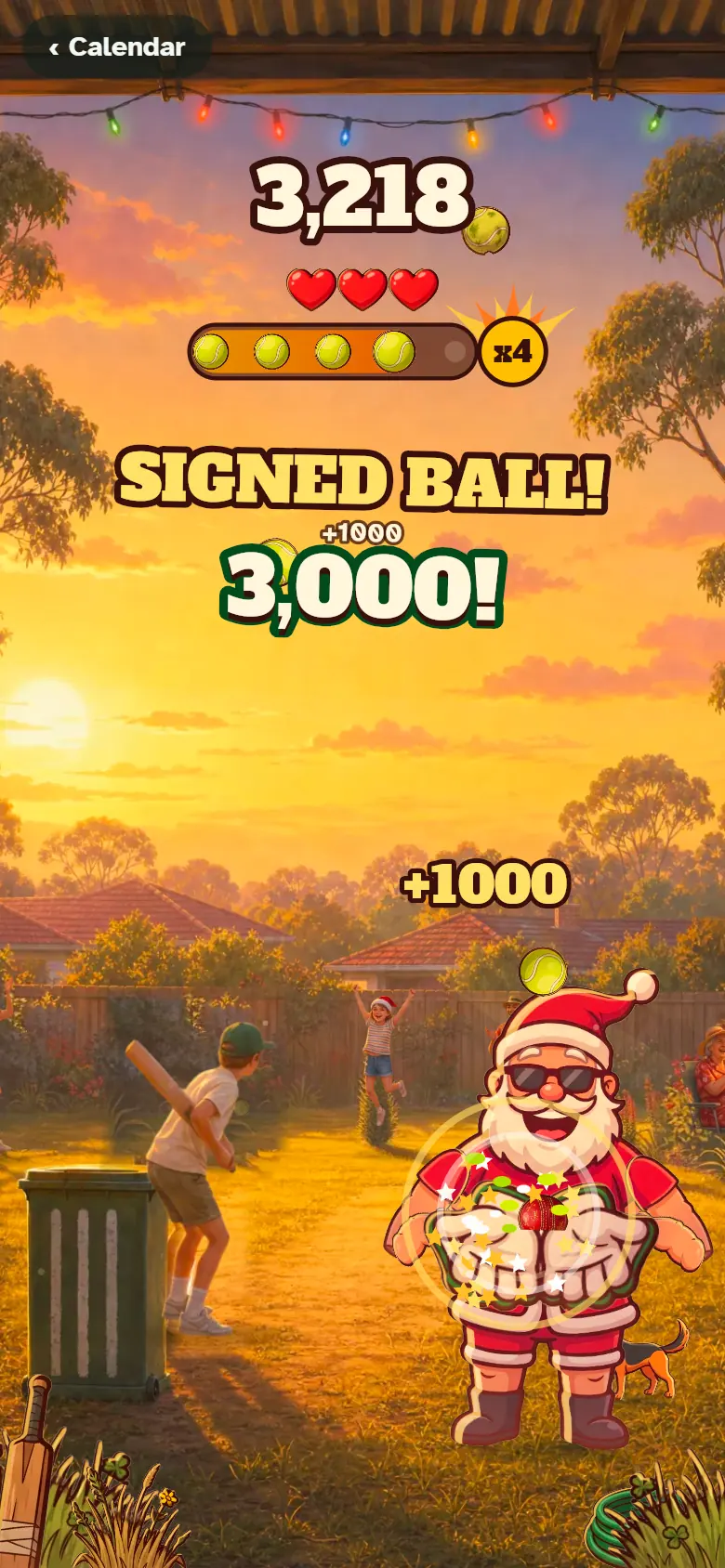
Our Backyard Cricket game (Door 9 of Sunburnt Santa) is all about the fielding. Tennis balls come flying off the roof and you slide Santa's hands to catch them. One hand, one bounce applies: a ball caught after one bounce is worth half, and a ball that bounces twice costs a life. Watch out for bindis, the prickly lawn weeds that every barefoot Aussie kid knows; the red ring on the lawn shows where each one will land. It's one of 24 mini-games in our free advent calendar game, and the rest of the day is covered in our guide to Christmas in Australia.
Keep reading
Sources
- Digital cricket wicket invention aims to take the anarchy out of Australian backyards, ABC News
- Backyard cricket: The Official Rules (by Steve Waugh), North West Telegraph (West Australian Newspapers)
- Kleenheat's ultimate backyard cricket rules, Kleenheat
- Yeppoon Backyard Cricket Series raises the bat for its 10th year of Queensland's local Ashes, ABC News
- Backyard cricket, Wikipedia
- The surprisingly short history of the Boxing Day Test, ABC News
- Slip, Slop, Slap, Seek, Slide, Cancer Council Australia