Christmas in Australia: the complete guide
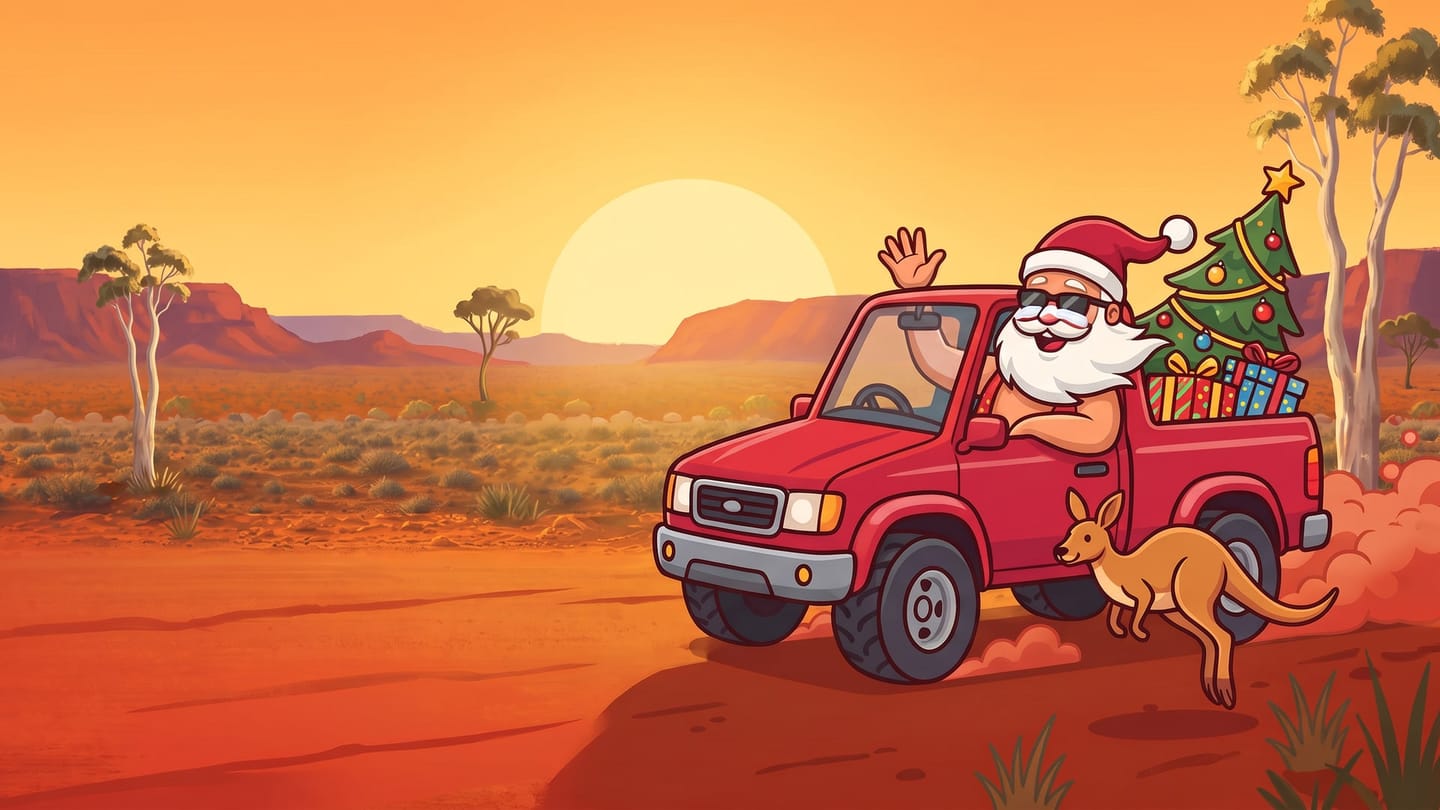
Christmas in Australia lands in the middle of summer, so the day looks less like a snow globe and more like a long, hot lunch: seafood and cold ham, a pavlova, a swim, a game of backyard cricket and a nap in the shade. The traditions came from the northern hemisphere, but since European settlement Australians have bent them to fit 30-degree days, and in a few places, a tropical wet season.
This guide covers what an Aussie Christmas actually involves, from the weather and the food to carols by candlelight, bon bons and Boxing Day, and how it changes depending on where in this very big country you are.
Why it's summer
Australia is in the southern hemisphere. Around 21 to 22 December the southern half of the Earth is tilted towards the Sun, giving Australia its summer solstice and longest days of the year [1]. Hobart gets about 15 hours of daylight at the summer solstice; Darwin, close to the equator, only about 12.5 [1]. For the full explanation, with every capital's December numbers, see why Christmas is in summer in Australia.
The weather: it depends where you are
"Hot" is the short answer, but Australia is a big country and Christmas weather varies a lot. Bureau of Meteorology long-term December averages give a feel for it:
| Place | December mean max | December mean min | December mean rainfall |
|---|---|---|---|
| Darwin (Airport) | 32.8 °C | 25.4 °C | 255.5 mm [2] |
| Cairns (Aero) | 31.5 °C | 23.4 °C | 193.8 mm [3] |
| Perth (Metro) | 29.6 °C | 16.6 °C | 9.6 mm [5] |
| Hobart (Ellerslie Road) | 20.4 °C | 10.9 °C | 56.6 mm [4] |
So a Perth Christmas is usually hot and bone dry, a Hobart Christmas can need a jumper by evening, and the tropical north is hot, sticky and getting wetter by the week.
Far North Queensland: Christmas in the build-up to the wet
Sunburnt Santa is made in Yungaburra on the Atherton Tablelands, in Far North Queensland, so this one is close to home. Up here December is the start of the wet season. Cairns averages about 194 mm of rain in December, then more than 400 mm in each of January, February and March [3]. Nights barely cool down: the December average minimum in Cairns is 23.4 °C [3].
The upside is fruit. Australian mango picking starts in the Northern Territory and Western Australia in September and works its way south and east through to January, and the Mareeba and Dimbulah growing areas, just down the road from us, pick in early to mid December [7]. Which is why, up north, a tray of mangoes on the Christmas table is close to compulsory. Driving to Christmas lunch up here can also mean slowing for wildlife, which is the whole story behind our cassowary crossing signs piece.
Sun-safe, always
The game is called Sunburnt Santa as a joke, not as advice. Christmas Day is often spent outdoors in strong summer sun, and the Cancer Council's long-running message still applies: slip on a shirt, slop on sunscreen, slap on a hat, seek shade and slide on wraparound sunglasses [6].
The food: cold, fresh and a bit of everything
A traditional British roast with plum pudding still turns up on plenty of Australian tables, sometimes eaten with the air conditioner going flat out. But lots of families have shifted to food that suits the heat: cold ham and turkey, prawns and other seafood, salads, and summer fruit like cherries and mangoes.
The dessert most associated with an Aussie Christmas is the pavlova ("pav"): a big meringue with a crisp shell and a soft middle, piled with whipped cream and fruit. Australians often top it with passionfruit, while New Zealanders tend to reach for kiwifruit [8]. Both countries claim to have invented it, and the argument is still going; we lay out the evidence fairly in who invented the pavlova.
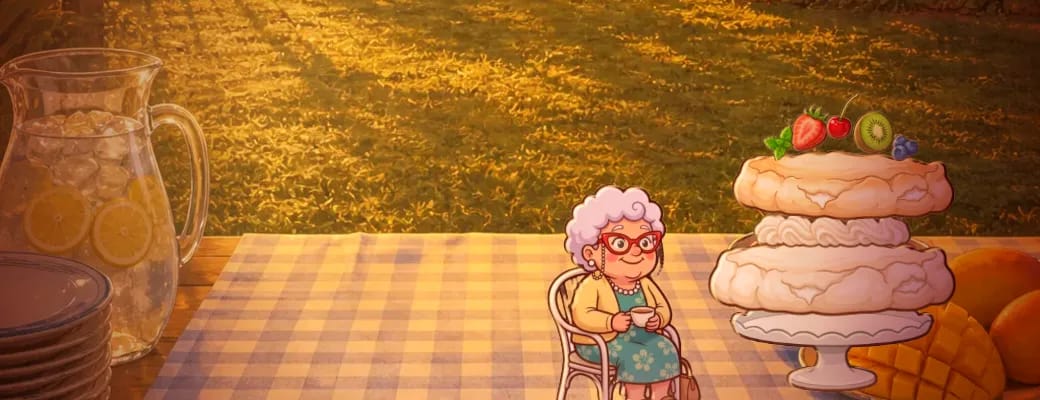
A few words overseas readers will hear at the table: snags are sausages, an esky is a portable cool box, thongs are flip-flops, and Chrissy is Christmas. There are plenty more in our Aussie Christmas slang guide.
Carols by Candlelight
On the nights before Christmas, parks and ovals around the country fill with people holding candles and singing carols. The best-known event is Melbourne's Carols by Candlelight, now run by Vision Australia. Its own history says radio broadcaster Norman Banks came up with the idea on Christmas Eve 1937, after seeing an elderly woman singing along to "Away in a Manger" on the radio, her face lit by a single candle [9]. The first event, in Alexandra Gardens in 1938, drew around 10,000 people, and since 1959 it has been held at the Sidney Myer Music Bowl [9]. Ticket sales and donations fund Vision Australia's services for children who are blind or have low vision [9].
Plenty of suburbs and country towns run their own smaller version, often with a sausage sizzle and kids in tinsel.
Backyard cricket
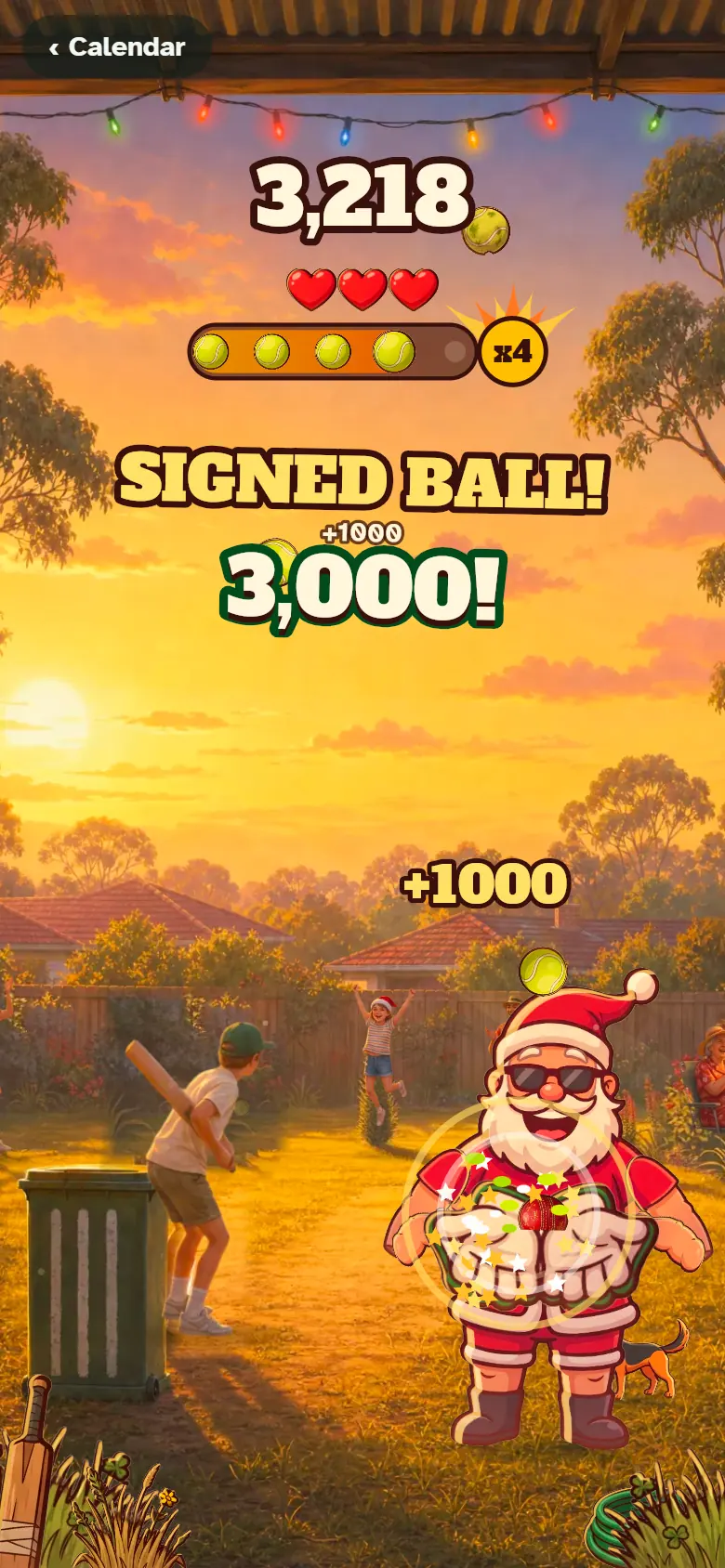
After lunch, someone finds a bat. Backyard cricket is a loose, family version of the real game, played with a tennis ball and, often, a garbage bin for a wicket [10]. Every backyard has its own rules. Hit it over the fence and it's "six and out", and a catch taken one-handed after one bounce is out under the famous "one hand, one bounce" rule [10]. A broken window usually ends the innings, or the game [10].
We've written up the common house rules, with a printable table and tips for keeping it fair for little kids, in backyard cricket rules.
Bon bons
The table is set with bon bons, which is what most Australians call Christmas crackers: a paper tube you pull with the person next to you until it snaps. Inside are a paper crown, a small toy and a terrible joke. Australian museum collections record them as "Christmas crackers or bon bons" [12].
The cracker itself is a Victorian London invention. Confectioner Tom Smith is credited with developing it from the French bon bon, a sugared almond wrapped in a twist of paper, and patented his first cracker in 1847 [11]. The full story, including the chemistry of the snap, is in what is a Christmas bon bon.
A typical Aussie Christmas Day
No two families do it the same way, but if you dropped in on a suburban Christmas you would probably see something like this:
- Early morning: presents under the tree, opened before it gets too hot. Kids in new swimmers by 8 am.
- Mid-morning: church for some families, a drive to the rellies (relatives) for others. Someone is sent out for ice.
- Lunch, around 1 pm: the main event. Tables pushed together on the veranda or under a tree, bon bons pulled, paper crowns on, a cold spread with prawns, ham and salads, maybe a roast as well if Nan insists. Pav or pudding to finish, often both.
- Afternoon: backyard cricket, the pool, the beach or a nap, depending on age and how much pav was involved. The esky is restocked with soft drinks and water.
- Evening: leftovers, a phone call to family overseas who are just waking up to their own Christmas morning, and an argument about who washes up.
Two things stand out to visitors. The first is how much of the day happens outside. The second is how relaxed it is: the menu, the dress code and the rules of the cricket are all negotiable, as long as everyone gets fed and nobody gets burnt.
Santa, Aussie style
Santa still comes on Christmas Eve, though in the heat he has every reason to lose the fur coat. Our own Santa drives a red ute (a pickup, to Americans) through the outback. There is a real-life precedent for an outback Father Christmas, too, which we tell in the real Sunburnt Santa on the Tea and Sugar train.
Northern-hemisphere decorations survive the heat: trees, tinsel and fairy lights on the house. Australian wildlife gets involved as well. If cockatoos have ever had a go at your outdoor lights, we've looked into why cockatoos rip off Christmas lights. And the Christmas beetle, a shiny native beetle of the genus Anoplognathus, is one of 36 species in its genus, all but one found only in Australia [17].
Boxing Day
26 December is Boxing Day, a public holiday right across Australia. In South Australia it is called the Proclamation Day holiday [13]. When it falls on a weekend, most states add a holiday on the Monday; in 2026, Boxing Day is a Saturday, so most of the country also gets Monday 28 December off [13].
For many families Boxing Day means leftovers, the beach and the cricket on TV. The Boxing Day Test at the Melbourne Cricket Ground feels ancient, but it is younger than you'd think. The first international Test at the MCG over Boxing Day was in 1950, and there were only four more there before 1980 [14]. It has been held at the MCG every year since 1980, except 1989 when a one-day international was played instead [14]. One historian quoted by the ABC linked its rise to Channel Nine winning the broadcast rights in 1979 [14].
How Christmas changes around the country
- Tropical north (Darwin, Cairns, the Top End and Far North Queensland): hot and humid, with the wet season building. Seafood, mangoes and the air conditioning do a lot of work.
- Perth and the west: dry heat and sea breezes. December rain in Perth averages under 10 mm [5].
- The south-east (Sydney, Melbourne, Adelaide, Canberra): warm to hot, with the odd cool change. A beach or a pool is never far from the plan.
- Hobart and Tasmania: the mildest Christmas of the capitals, with average December maximums around 20 °C [4] and long evenings.
- The outback: big distances, small towns and very hot days. Christmas often means travelling a long way to get the family together.
A First Nations perspective
Aboriginal and Torres Strait Islander peoples are the First Peoples of Australia, here for thousands of years before colonisation [15]. Christmas arrived with European settlement; it is one layer on top of much older ways of reading the year.
Many First Nations communities describe the year through seasons marked by what is happening on Country rather than by dates. The Bureau of Meteorology hosts several of these calendars, shared by their communities. The Nyoongar calendar of south-west Western Australia, for example, has six seasons; December and January fall in Birak, the first summer, when the rains ease, afternoon sea breezes set in, fledglings leave the nest, and which was traditionally the time for burning Country in mosaic patterns [16]. The Nyoongar calendar notes that these seasons can be long or short and are read from nature, not the calendar [16].
Today plenty of Aboriginal and Torres Strait Islander people celebrate Christmas, and plenty don't, and there is no single "Indigenous Christmas". If you want to understand the season where you live, the seasonal calendar of the local Traditional Owners is a good place to start.
Christmas, Sunburnt Santa style
We made Sunburnt Santa because an Aussie Christmas is a bit ridiculous and we love it. It's a free advent calendar game with 24 Aussie Christmas mini-games, one door a day: stack a pav before Nan sees it, catch tennis balls off the roof in Backyard Cricket, win the bon bon pull against Cousin Kylie, and build the whole Christmas lunch, prawns to mango cheek, in Christmas Lunch Stack. You can play it in your browser at /play/, no snow required.
Keep reading
- Why is Christmas in summer in Australia?
- Aussie Christmas slang: a dictionary for visitors
- Countries where Christmas is in summer
Sources
- Solstices, equinoxes and the seasons, Bureau of Meteorology
- Summary statistics, Darwin Airport (station 014015), Bureau of Meteorology
- Summary statistics, Cairns Aero (station 031011), Bureau of Meteorology
- Summary statistics, Hobart (Ellerslie Road) (station 094029), Bureau of Meteorology
- Summary statistics, Perth Metro (station 009225), Bureau of Meteorology
- Slip, Slop, Slap, Seek, Slide, Cancer Council Australia
- Where do my mangoes come from?, Australian Mangoes (Australian Mango Industry Association)
- Settling the debate over whether Australia or New Zealand invented the pavlova, ABC News
- Our history, Vision Australia's Carols by Candlelight
- Digital cricket wicket invention aims to take the anarchy out of Australian backyards, ABC News
- The Christmas cracker, Victoria and Albert Museum
- Box of Christmas Crackers (HT 2022.0034), History Trust of South Australia
- 2026 public holidays, Fair Work Ombudsman
- The surprisingly short history of the Boxing Day Test, ABC News
- First Peoples of Australia, AIATSIS
- Nyoongar calendar, Bureau of Meteorology
- Christmas Beetles, Australian Museum