Door 5 · Stacker
Stack the Pav: Day 5 of Sunburnt Santa
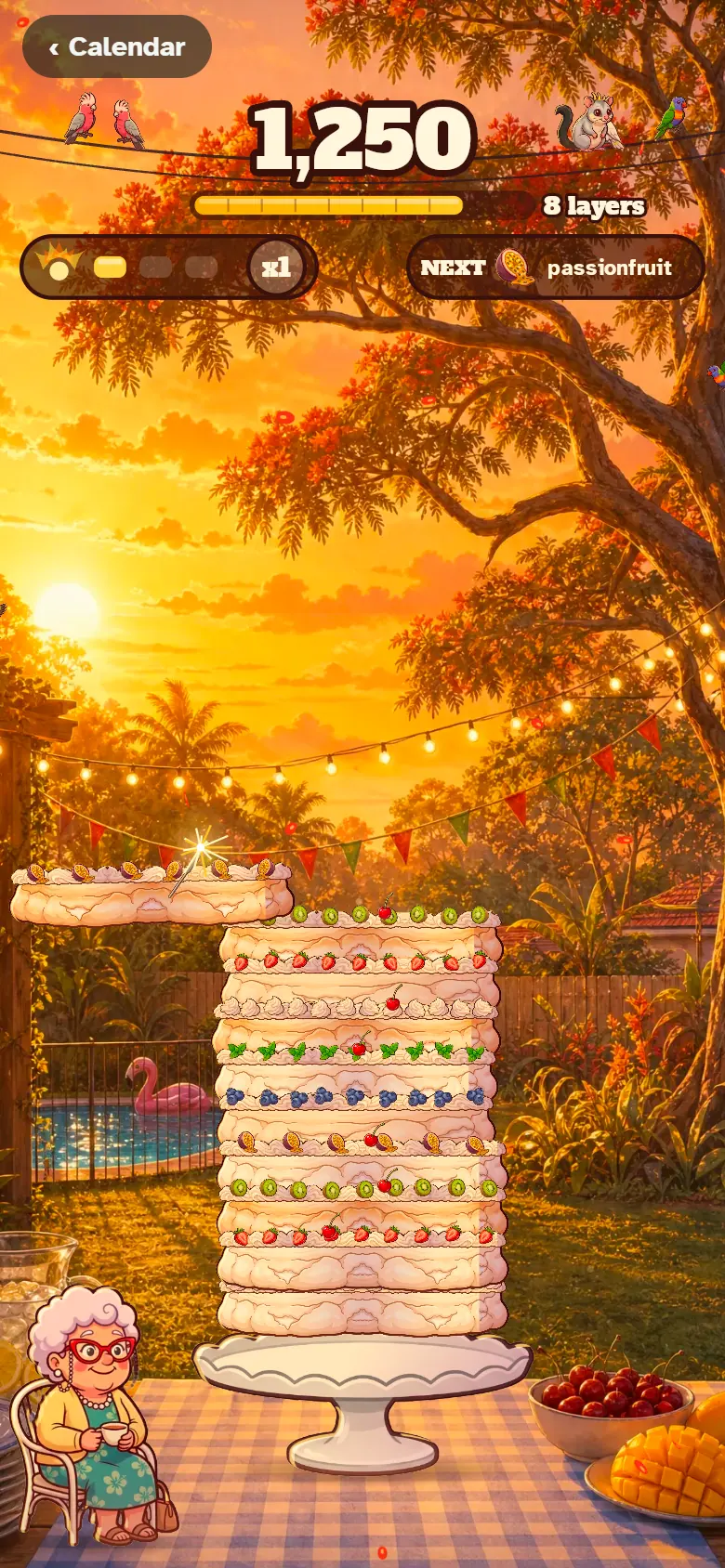
Meringue layers swing across the screen; tap to drop each one onto the pav and build it as high as you can. Whatever hangs over the edge gets sliced off, so every sloppy drop makes the next one harder.
How to play Stack the Pav
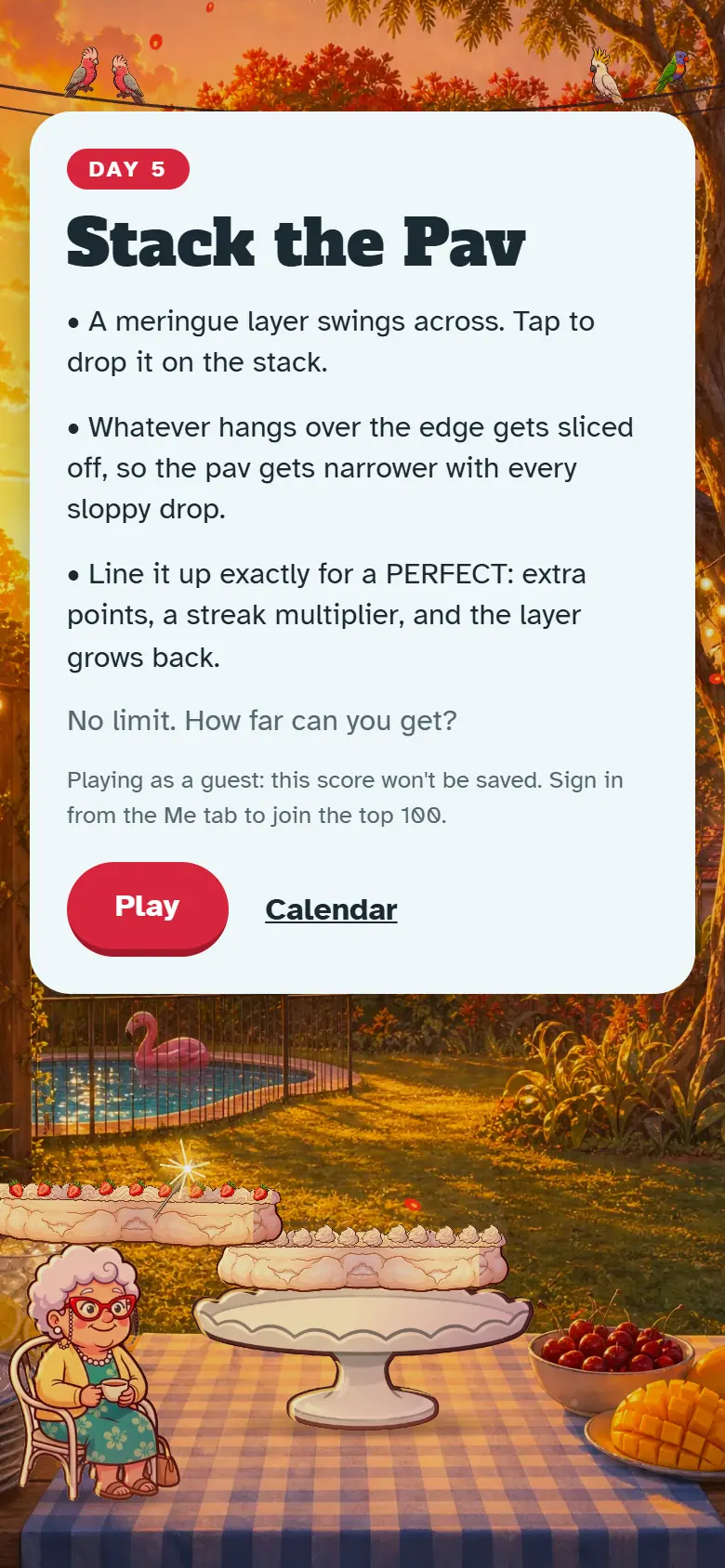
- A meringue layer swings across. Tap to drop it on the stack.
- Whatever hangs over the edge gets sliced off, so the pav gets narrower with every sloppy drop.
- Line it up exactly for a PERFECT: extra points, a streak multiplier, and the layer grows back.
Scoring
| What | Points |
|---|---|
| Layer landed | 100 |
| PERFECT layer (lined up exactly) | 150 |
| Clean miss | ends the round |
PERFECT drops in a row build a streak multiplier: x2 from the 3rd, up to x5 from the 12th. Any drop that isn't perfect resets it. Each layer swings a little faster than the last.
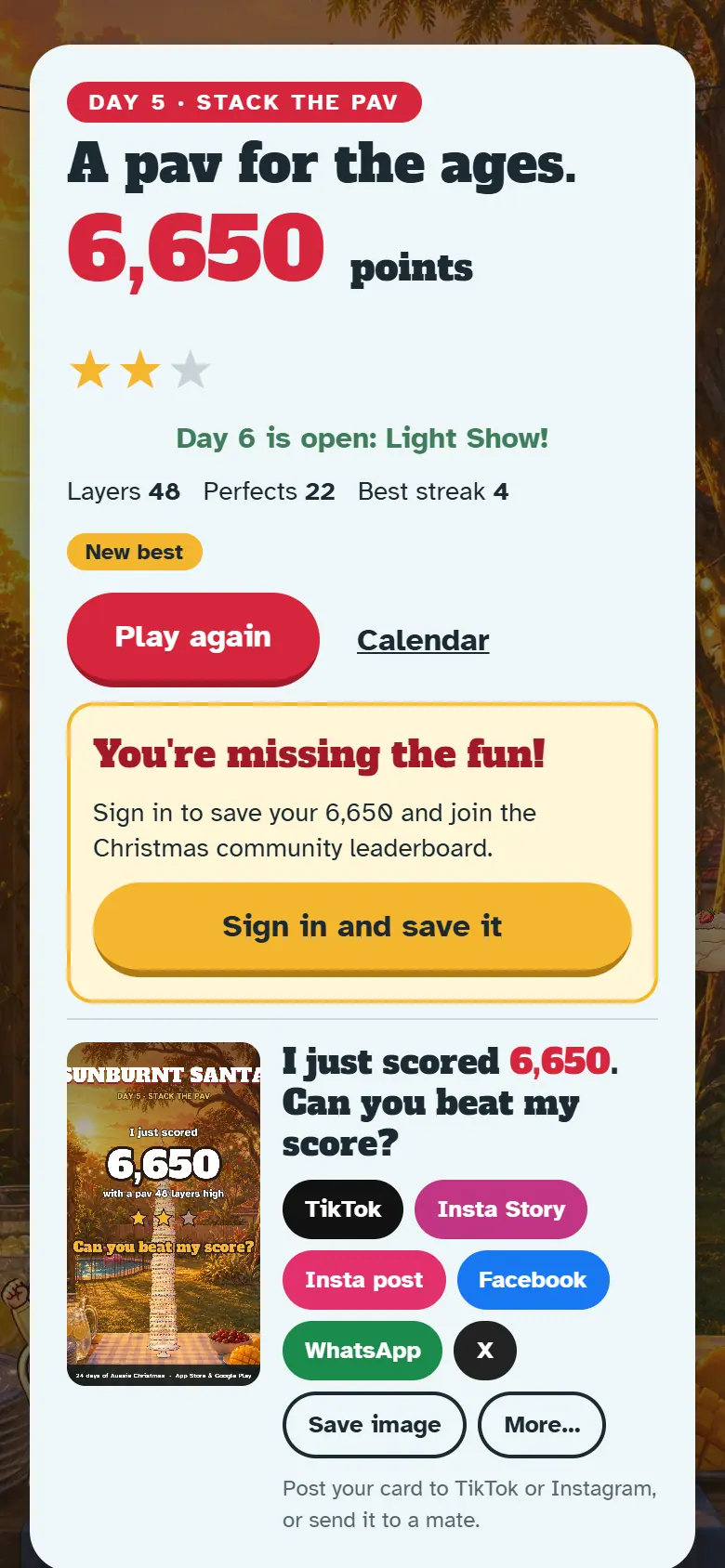
Stars: the three targets
Stars don't lock anything; they show how you're going, and doors with at least one star count towards the bonus games.
Tips for three stars
- Plain layers are only worth 100, so three stars comes from PERFECT streaks. From the 12th perfect in a row, every layer is worth 750.
- A PERFECT means landing within a few pixels of dead centre, and it does more than score: the pav grows back a little wider. A couple of perfects after a sloppy patch buys you room to breathe.
- There's no clock. The layer swings right across the screen and back, so if a pass looks wrong, let it go and wait for the next one. The round only ends on a clean miss or when the pav is sliced too thin to stand, and the swing gets quicker as the pav grows.
The real story: who invented the pavlova?
The pavlova, a meringue cake with a crisp shell, soft middle and a load of cream and fruit, is the Christmas dessert on countless Australian tables, and who made it first is still argued over. It was probably named for the ballerina Anna Pavlova after her hugely successful 1926 tour of Australia and New Zealand [1].
Australia's claim rests on Bert Sachse, a chef at the Esplanade Hotel in Perth, who created a new afternoon-tea cake in 1935; the manager reportedly said it was "as light as Pavlova" [1]. New Zealand's case is built on the recipe books. Culinary anthropologist Helen Leach of the University of Otago found that the first recipe everyone agrees is a pavlova appeared in New Zealand in 1929, and she counted at least 21 New Zealand pavlova recipes by 1940, the year the first Australian ones appeared [2]. Sachse himself said in 1973 that he had adapted a recipe sent to an Australian magazine by a New Zealand reader [1]. Other researchers trace big cream-and-fruit meringues back more than two centuries, to German-speaking Europe [1].
So: probably named in honour of a Russian dancer, first written down in New Zealand, and eaten with great enthusiasm on both sides of the Tasman. Nan has opinions either way.
Read more: Who invented the pavlova? Australia vs New Zealand.
When it opens
Door 5 opens on day 5 of your own calendar (your Day 1 is the day you first play), and for everyone by 5 December. Play the door before it to open it. Once it's open you can replay it as often as you like, and after Christmas Eve all 24 doors stay open. How the calendar works.
Play now
Same kind of game: Present Tower, Sandy Claus, Christmas Lunch Stack.
Sources for the real story
- The story behind pavlova, the dessert that sparked an international rivalry, National Geographic
- The great pavlova debate, The Canberra Times