Who invented the pavlova? Australia vs New Zealand
Nobody can say for certain who invented the pavlova, but the evidence points to this: the dessert is named after the Russian ballerina Anna Pavlova, the earliest known recipes using her name were published in New Zealand in the late 1920s, and Australia's claim rests on Perth chef Bert Sachse, who said he created his version in 1935. Historians on both sides of the Tasman (the sea between Australia and New Zealand) also point out that big meringue cakes with cream and fruit were around long before either country put a name on one.
Here's the evidence, as fairly as we can lay it out. (Disclosure: we're an Australian studio. We've tried very hard not to let that show.)
The ballerina
Anna Pavlova was one of the most famous dancers in the world in the early 20th century, known above all for The Dying Swan. She died of pneumonia in 1931 [3].
She toured Australia twice with her company of about 40 dancers, in 1926 and 1929 [2]. The 1926 tour took in Melbourne, Sydney, Brisbane and Adelaide [2], and she went on to New Zealand [3]. The 1929 tour went further: regional Queensland and Brisbane, then Sydney, Melbourne, Adelaide and, importantly for this story, Perth [2].
Everyone agrees the dessert is named after her. The argument is about who named it first, and what "it" was.
New Zealand's case
The Wellington story, and why it doesn't hold up
The popular New Zealand version says a chef at a Wellington hotel created the dessert for Pavlova during her 1926 tour [8]. The problem is evidence. Helen Leach, an emeritus professor at the University of Otago, could not verify the story of an unnamed Wellington hotel chef [4].
What the cookbooks show
Leach went through early cookbooks instead and published her findings in The Pavlova Story: A slice of New Zealand's culinary history in 2008 [3]. The University of Otago calls it a best seller [9]. She found three different desserts called "pavlova" in New Zealand recipe books before 1930 [3]:
- A layered jelly, from the Davis Gelatine company's recipe book. Sources disagree on which edition came first: Te Ara says an Australian recipe book used the name for a multi-layered jelly in 1926 [1], while the ABC and RNZ describe the 1927 New Zealand book Davis Dainty Dishes [3] [6].
- Small coffee and walnut meringues, published in Dunedin in 1928 [4].
- A large meringue cake. In 1929 The New Zealand Dairy Exporter published a recipe for "pavlova cake", a large baked meringue cake [1]. Te Ara, New Zealand's national encyclopedia, says Leach's research established that this was the first known recipe for pavlova as we now understand it [1].
Another early New Zealand recipe, from the 1933 Rangiora Mothers' Union cookbook, is the next oldest in that line [5].
The dictionary weighs in
In 2010 the relaunched online Oxford English Dictionary said the first recorded pavlova recipe appeared in New Zealand in 1927 [7]. The catch, as reported at the time, is that the 1927 recipe was the Davis jelly, a multi-coloured dish nobody would mistake for a pav today [6].
Australia's case
Bert Sachse at the Esplanade Hotel, Perth
Australia's claim centres on Herbert "Bert" Sachse, the chef at the Esplanade Hotel in Perth. In 1935 he was asked for something new for afternoon tea; the story goes that when it was served, the manager said it was "as light as Pavlova" [5]. Pavlova had visited Perth on her 1929 tour [2], and she had died four years before Sachse's cake.
Cultural historian Carmel Cedro told the ABC that the first Australian version of the dessert was recorded in 1935, from Sachse at the Esplanade, and that it was a thick meringue cake close to the modern pav [3].
The complication
In a 1973 interview, Sachse said his creation was an adaptation of a recipe from the Australian Woman's Mirror magazine, contributed by a reader living in New Zealand [5]. A Sachse descendant has also suggested he may have confused his dates [5]. Neither point means Sachse didn't make a famous pavlova. They do make "invented it from scratch in 1935" hard to defend.
The plot twist: it's older than both
The most recent research goes back further. Andrew Paul Wood and Annabelle Utrecht spent seven years on the pavlova's history for their book Beat Until Stiff [4]. They found:
- a "Strawberries Pavlova", actually a raspberry glacé, in the New Zealand Herald in 1911, which Utrecht believes was reprinted from England [4];
- large meringue cakes filled with cream and fruit, such as the Austrian Spanische Windtorte, baked in Habsburg kitchens in the late 1700s, which Wood calls the "great, great granddaddy" of the pav [4];
- hundreds of recipes named after Anna Pavlova in the northern hemisphere [4].
When Utrecht baked the 1929 New Zealand recipe, she found it was a meringue sandwich rather than today's pavlova; single-layer cakes topped with fruit and cream appear around 1932 to 1933 [4]. Australian food historian Michael Symons has written that numerous home cooks in both countries created the pavlova at roughly the same time [8].
So who wins?
Here's our honest scorecard:
| Question | Best answer from the evidence |
|---|---|
| Who is it named after? | Anna Pavlova. Everyone agrees. |
| Who used the name first? | New Zealand, in recipe books from the late 1920s [1] [3] |
| Who published the first big meringue cake called pavlova? | New Zealand, 1929 [1] |
| Is Australia's Sachse story real? | A real chef and a real dessert, recorded in 1935 [3], but with an admitted debt to a New Zealand reader's recipe [5] |
| Who invented meringue, cream and fruit? | Neither. European kitchens were doing it in the 1700s [4] |
The ABC's 2024 summary landed on a compromise: New Zealand was first to use the name, and Australia was first to create the recipe now known as the modern pavlova [3]. Plenty of New Zealanders would dispute the second half. We'd say the pav belongs to both countries, which is the one answer guaranteed to annoy everyone.
What makes a good pav
A pavlova is not just a big meringue. A meringue is crisp all the way through; a pavlova is crisp on the outside with a soft, foamy centre [8]. Utrecht's and the dictionary's working definition is simple: cream and fruit on top of a meringue [8].
- The base: egg whites and caster sugar, usually with a little cornflour, which helps give that thick, marshmallowy middle, and a teaspoon of white vinegar [5].
- Stability: Baker Natalie Paull suggests cream of tartar to stabilise the meringue and whipping at just under high speed [3].
- Shape: pile it high and flatten it only a little, because it spreads in the oven [3].
- Style: Australian pavs are often described as crunchier and topped with passionfruit; New Zealand ones as softer and more marshmallowy, topped with kiwifruit [3].
- Topping: cream goes on just before serving, then fruit. In an Australian December that often means berries, mango, passionfruit and cherries.
Play it: Stack the Pav
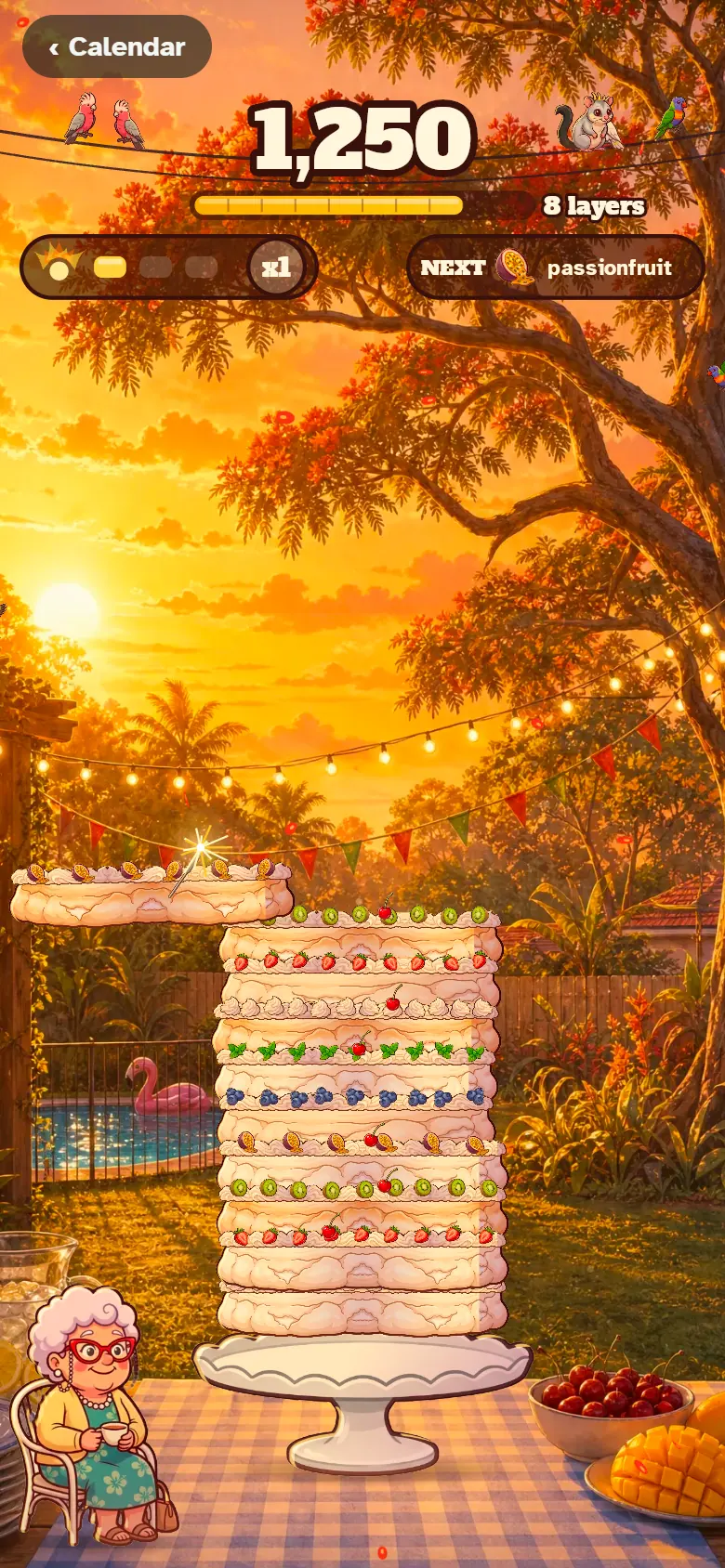
The pavlova gets its own door in Sunburnt Santa. In Stack the Pav (Door 5), meringue layers swing across and you tap to drop each one on the stack. Anything hanging over the edge gets sliced off, so the pav gets narrower with every sloppy drop, but a PERFECT drop builds your streak and grows the layer back. On Door 22, Christmas Lunch Stack, the pav is one course in a tower that runs from turkey to mango cheek, and Nan has opinions about all of it. More on the rest of the day in our guide to Christmas in Australia.
Keep reading
Sources
- Cooking: Cooking methods (David Burton), Te Ara: the Encyclopedia of New Zealand
- Anna Pavlova, National Portrait Gallery (Australia)
- Settling the debate over whether Australia or New Zealand invented the pavlova, ABC News
- The surprising truth about pavlova's origins, RNZ
- The story behind pavlova, the dessert that sparked an international rivalry, National Geographic
- OED takes stance on pavlova recipe, RNZ
- Egg on our face as Kiwis claim pavlova, ABC News
- Pavlova is an iconic summer dessert with a contested history, ABC News
- The Pavlova Story (A Record of Achievement exhibition, cabinet 17), University of Otago Library