Bin chickens: why Australians call the ibis a bin chicken
Australians call the Australian white ibis a "bin chicken" because, in cities, that's where you find it: head-first in a rubbish bin, fishing out scraps with its long curved bill. The Macquarie Dictionary explains the name exactly that way, as a reference to the bird's habit of rummaging in garbage bins for food [2].
The longer story is more interesting, and a bit sadder, than the joke. The bin chicken is a wetland bird that moved to town, and the name says as much about us as it does about the ibis.
Meet the bird
The Australian white ibis (Threskiornis molucca) is a big wading bird, 69 to 76 cm long, with an almost entirely white body, a bald black head and neck, and a long, down-curved black bill [1]. Adults have a tuft of cream plumes at the base of the neck [1]. It is common in northern and eastern Australia, has been spreading in Western Australia (where it was absent before the 1950s), and is absent from Tasmania [1].
Out in its natural habitat, the ibis lives around swamps, lagoons, floodplains and grasslands, eating invertebrates on land and in the water; its favourite foods are crayfish and mussels, which it digs up with that bill and opens by hammering them on a hard surface [1]. It nests in big colonies, often alongside straw-necked ibis [1].
That bill, built for probing mud, turns out to be equally good for probing a wheelie bin.
Why did ibis move into cities?
Ibis visited Sydney in the 1970s, but the first breeding records in the city date from the 1980s [3]. The Macquarie Dictionary notes the bird has been moving into urban areas along the east coast since the 1970s [2].
There are two parts to the explanation.
Drought, dams and drying wetlands. Australian Museum scientist Richard Major, who had studied ibis for 34 years when he spoke to the ABC in 2018, said the most likely explanation is environmental degradation. In the 1980s about 15,000 ibis nested in colonies in one flooded wetland in the Murray-Darling Basin, numbers no longer seen there, and drought and river regulation probably pushed ibis toward the coast, where cities offer reliable fresh water and food [3]. The Australian Museum's species page makes the same point from the other direction: although the ibis is becoming more common in some areas, "their abundance is decreasing in their natural range" [1].
A helping hand from the zoo. In 1973, 19 ibis from Healesville in Victoria were held at Taronga Zoo on Sydney Harbour and encouraged to breed as free-ranging birds [3]. Major said it would be unfair to blame the zoo for Sydney's ibis, but reasonable to suspect the program acted as a "nucleation point" that helped wild ibis settle into city life [3].
So the bin chicken probably isn't a sign that ibis are booming. Major told the ABC the overall population has probably declined; ibis just seem more numerous now because they live where most of us live [3]. By 2018 Sydney alone had an estimated 10,000 [3].
Where did the name "bin chicken" come from?
Nobody has pinned down the first person to say it, and we won't pretend to. What is documented is that ibis have entered Australian English under a handful of affectionate insults. The Macquarie Dictionary lists "dump chook" and "tip turkey" alongside "bin chicken" [2], and the Australian Museum now gives Bin Chicken as an alternative name for the species on its own page [1].
For overseas readers: a "chook" is Australian for a chicken, a "tip" or "dump" is a rubbish tip (a landfill), and a "bin" is a rubbish bin. All three names say the same thing: big white bird, eats our rubbish, struts around like it owns the place.
From pest to national mascot
Somewhere along the way, the joke turned into affection. In a 2018 essay for The Conversation, cultural researchers Paul Allatson (University of Technology Sydney) and Andrea Connor (Western Sydney University) called the ibis "the new animal totem for thinking about the very idea of 'Australia'" [4]. They listed the evidence: ibis gift cards, tote bags, clothing, cups, tea towels, children's books, tattoos, murals, a crowd-funded inflatable pool ibis, the 2017 mockumentary Planet Earth: Bin Chicken, and "International Glare at Ibises Day" on 21 December 2016, which nearly 8,000 people registered for in Sydney [4]. The ABC found a Sydney jeweller making bin chicken earrings and a Queensland cake-maker who'd made an ibis birthday cake [3].
The high point came in December 2017, in the 2017 Australian Bird of the Year poll, the first that BirdLife Australia ran together with Guardian Australia. The white ibis came second with 19,083 votes, just behind the magpie on 19,926, with the laughing kookaburra third on 10,953; almost 150,000 votes were cast [5]. Losing by 843 votes only made the ibis more beloved.
Bin chicken facts at a glance
| Species | Australian white ibis, Threskiornis molucca [1] |
| Size | 69 to 76 cm [1] |
| Natural diet | Invertebrates; favourites are crayfish and mussels [1] |
| City diet | Human scraps [1] |
| Other nicknames | Dump chook, tip turkey [2] |
| In cities since | Visiting Sydney in the 1970s; breeding there from the 1980s [3] |
| Bird of the Year 2017 | Second, 843 votes behind the magpie [5] |
| Legal status | Protected native bird (for example under Queensland's Nature Conservation Act 1992 and NSW's Biodiversity Conservation Act 2016) [6] [7] |
Living with bin chickens at Christmas
The ibis is a protected native bird. Brisbane City Council notes that it is protected under Queensland's Nature Conservation Act 1992 [6], and in New South Wales all native birds are protected under the Biodiversity Conservation Act 2016, which makes it an offence to harm them without a licence [7]. Its city numbers are pushed up by the food we leave around, so the best thing you can do for the bird is not to feed it.
Christmas and summer holidays mean picnics, parks and full bins, so a few easy habits help:
- Don't feed them. Brisbane City Council strongly advises against feeding ibis and asks people not to leave scraps lying around [6].
- Close the lid. Keep bin lids shut, especially on big bins after a party or barbecue [6].
- Plant natives. The council suggests planting native trees rather than exotic palms, which ibis like for nesting and roosting [6].
Play it: Bin Chicken Blitz
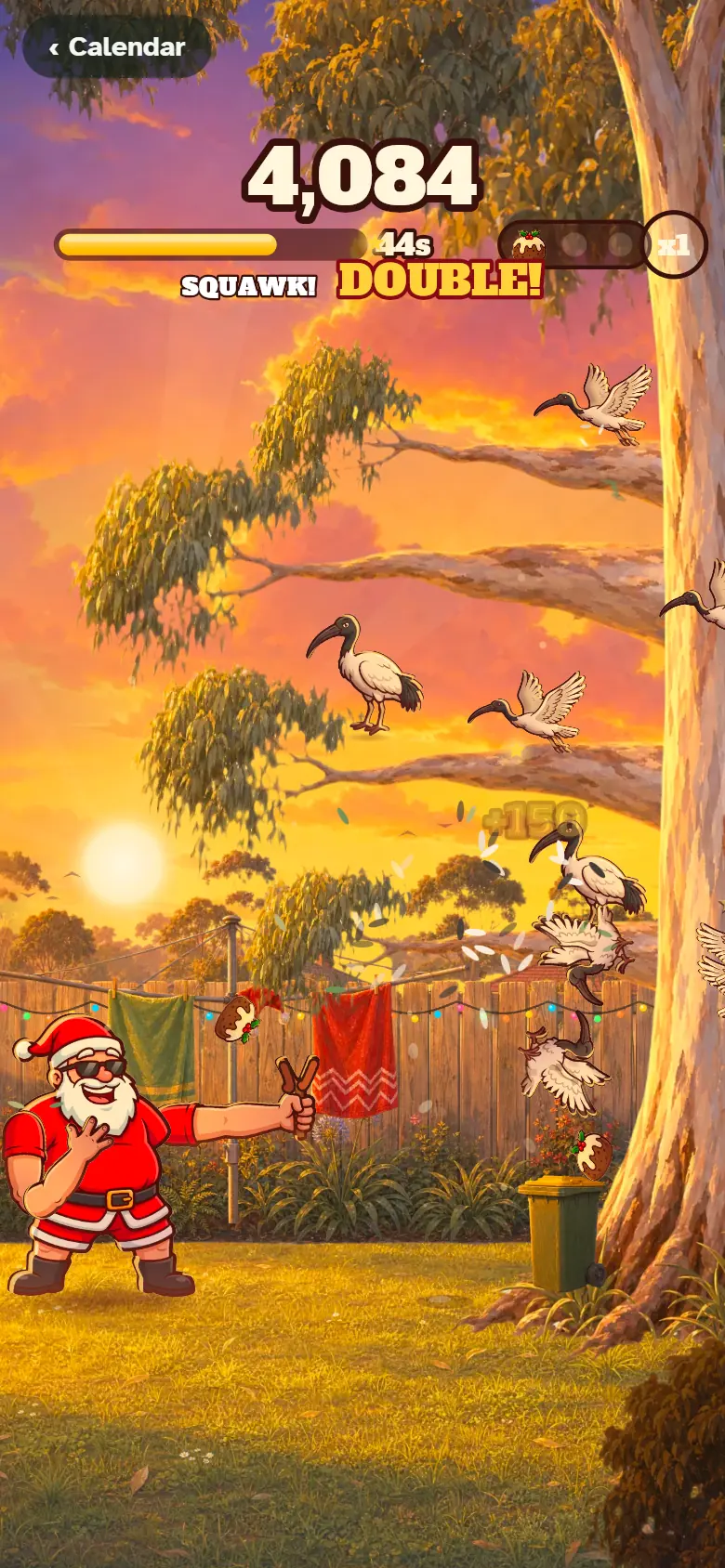
Door 2 of Sunburnt Santa is our love letter to the bird. In Bin Chicken Blitz, bin chickens, magpies, galahs, cockies and lorikeets land in a gum tree for 60 seconds while you fling Christmas puddings with a slingshot. Bin chickens are the easy 100-pointers; the flighty lorikeet is worth 500. Every bird that's hit gets dazed and flies off to sulk, unharmed. The ibis turns up again on the final night too, flying low across Christmas Eve Run, and has its own page in our cast of characters.
Keep reading
- Why do cockatoos rip off Christmas lights?
- Aussie Christmas slang: a dictionary for visitors
- Christmas in Australia: the complete guide
Sources
- Australian White Ibis, Australian Museum
- All hail the bin chicken, Macquarie Dictionary (blog, 11 February 2021)
- Is Taronga Zoo responsible for Sydney's prolific ibis population?, ABC News (Harriet Tatham, 8 August 2018)
- The rise of the ibis: How the 'bin chicken' became a totem for modern Australia, ABC News / The Conversation (Paul Allatson and Andrea Connor, 7 September 2018)
- Magpie wins Australian bird of the year poll, ANU Fenner School of Environment and Society (11 December 2017)
- Living with wildlife, Brisbane City Council
- Living with native animals, NSW Department of Climate Change, Energy, the Environment and Water