Why do cockatoos rip off Christmas lights?
Cockatoos rip off Christmas lights because chewing is a big part of being a cockatoo: they bite and strip things to keep their bills in shape, they tear at bark to find food underneath, and a soft plastic cable flapping on a gutter seems to be good fun. They aren't after the lights themselves; your fairy lights just happen to be the most chewable thing on the roof.
Here's what's going on inside that crested head, what the research on Sydney's cockatoos tells us, and how to keep your lights up without hurting a feather.
Meet the culprit
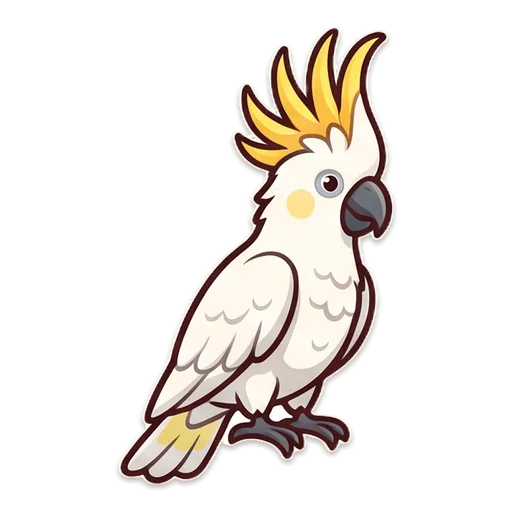
The usual suspect is the sulphur-crested cockatoo (Cacatua galerita), the big white parrot with the yellow crest and the screech you can hear three streets away. The Australian Museum describes it as "a noisy and conspicuous cockatoo, both at rest and in flight", found across northern and eastern Australia and Tasmania, with a small population around Perth [1]. It lives in timbered country, is common around towns, and stays in the same area all year [1]. Australians call it a cocky, and in Sunburnt Santa we do too.
They're long-lived (the museum notes they have reached eighty in captivity) and they live in families: chicks stay with their parents all year and family groups stay together indefinitely [1]. So the gang on your roof this December may well be the same gang that was there last December.
Why they chew
A bill that needs trimming
When they're not feeding, sulphur-crested cockatoos bite off small branches and leaves and drop them without eating them. Both the Australian Museum and BirdLife Australia suggest this habit may keep the bill trimmed and stop it growing too large [1] [2]. As Region Canberra put it in a 2022 piece on cockatoo damage, "much like a fingernail, a cockatoo's beak also grows perpetually, and needs to be kept in check by gnawing" [3]. A cable has about the right give for that job.
Stripping things is how they find food
Canberra naturalist Ian Fraser suspects that pulling the rubber and plastic strips off light fittings is an extension of the way cockatoos rip bark off trees to see what's living underneath [3]. A cockatoo's normal diet is berries, seeds, nuts and roots [1], and plenty of it is hidden under something that has to be torn open first.
They seem to enjoy it
Fraser's other explanation is simpler: "it's fun to swing on the dangling plastic cover" [3]. A bird with a full crop has time on its claws. Anyone who has watched a cocky hang upside down from a powerline will find that easy to believe.
And they're strong enough to do real damage
That bill is no toy. The Australian Museum says the sulphur-crested cockatoo can "destroy timber decking and panelling on houses" and counts as a pest in some urban areas [1]. In Canberra, the ACT Government told Region Canberra it had made 243 street light repairs for suspected or confirmed bird damage between April 2018 and August 2022, many of them caused by cockatoos and corellas chewing or removing wiring and photo-electric cells, or unclipping covers so water got in [3]. If they can do that to a council street light, a strand of fairy lights doesn't stand much of a chance.
Clever birds, and they learn from each other
Cockatoos don't just chew. A study led by Barbara Klump and Lucy Aplin of the Max Planck Institute of Animal Behavior, with John Martin of Taronga Conservation Society and Richard Major of the Australian Museum, found that Sydney's sulphur-crested cockatoos learn to open wheelie bins by watching other cockatoos [4]. The researchers trace the trick to a cockatoo in northern Sydney in late 2018; by the end of 2019 residents in 44 areas had seen it, and it spread faster to neighbouring suburbs than to distant ones [4]. Of about 500 birds the team marked with paint dots, only around 10 per cent could open bins, mostly males; the rest waited for the experts and helped themselves [4]. Different suburbs even used different techniques, which the researchers read as local subcultures [4].
In 2025 a team including researchers from the Max Planck Institute and Western Sydney University reported cockatoos in Western Sydney working public drinking fountains, getting the water to flow in 41 per cent of their attempts [5].
Nobody has published a study on Christmas-light pulling. But a bird that copies its neighbours' tricks, and lives in a family that sticks around, is exactly the kind of bird that will come back to a roofline it already knows.
How to keep your lights (and the birds) safe
Nothing is cockatoo-proof. Asked whether anything keeps cockatoos off lights, washing or fruit trees, Fraser's answer was "apparently not" [3]. These are practical ideas that make your lights a less tempting target, not guarantees.
| Try this | Why it helps |
|---|---|
| Run lights under the eaves, inside the gutter line or along a verandah beam, not along the ridge or the top of the gutter | Cockatoos land and sit on exposed edges. Lights tucked underneath are harder to reach from a perch. |
| Feed exposed lengths of cable through rigid conduit or a hard cable cover | A smooth, hard tube is less satisfying to chew than soft PVC. |
| Keep plugs, transformers and joins indoors or in a covered spot | The joins are the softest, most chewable bits, and the most dangerous if damaged. |
| Take lights down, or at least check them, after the season | Chewing tends to start on what's left up. |
| Never feed cockatoos | Feeding brings birds back to your house and keeps them there. The NSW Government advises that feeding native animals is "usually not good for them and can create problems for the community" [6]. |
| Secure your bins | Sydney's cockatoos have learnt to open them [4], and food keeps a flock nearby. |
Two safety notes. First, check any chewed mains-powered lights before you switch them on again, and replace damaged ones rather than taping them: a bare wire outdoors is a risk to you and to the bird. Second, never try to hurt, trap or poison cockatoos. In New South Wales all native birds are protected under the Biodiversity Conservation Act 2016, and it is an offence to harm, kill or remove them without a licence [6]. Check the rules in your own state, and leave out anything that could injure a bird: throwing things, sticky deterrents, traps, the lot.
The best defence is boring: put the lights where the birds don't sit, make the cable hard to chew, and don't give the flock a reason to hang around.
Play it: Cocky Chaos
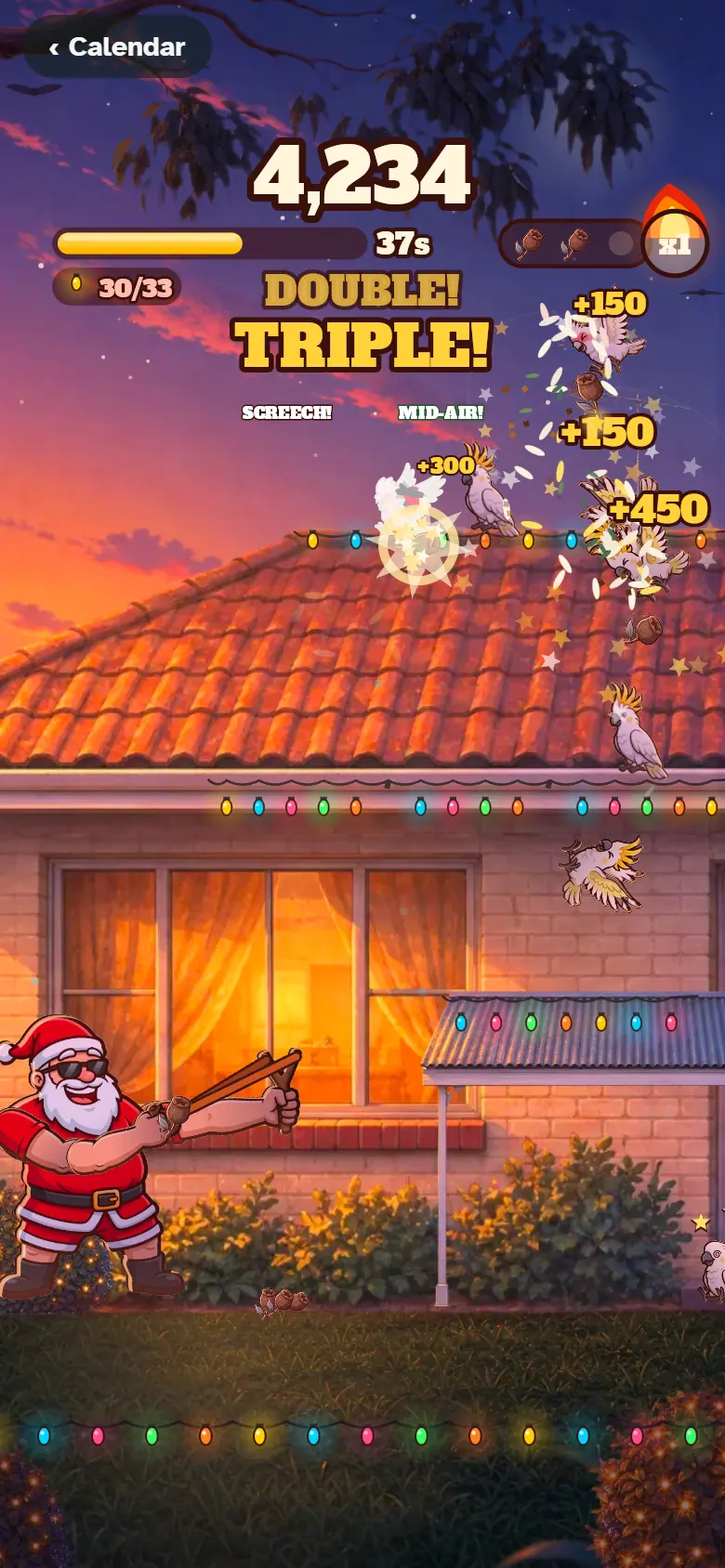
In Sunburnt Santa, door 14 turns your roof into a battle of wills. In Cocky Chaos, cockies, corellas, galahs and the occasional black cockatoo land along the roofline for 60 seconds. Any cocky that sits for 6 seconds starts pulling bulbs off the fairy lights, and each bulb costs you 75 points, so you flick gum nuts with a slingshot to shoo them off. Cockies are worth 100, corellas 150, galahs 200 and the rare black cockatoo 500. Nobody gets hurt: a bird that's hit gets dazed and flies off, which is exactly how we'd like it in real life too. For the other half of Australia's feathered troublemakers, read about the bin chicken, or open today's door in the advent calendar game.
Keep reading
- Christmas in Australia: the complete guide
- Bin chickens: why Australians call the ibis a bin chicken
- Cassowary crossing signs: Christmas driving in Far North Queensland
Sources
- Sulphur-crested Cockatoo, Australian Museum
- Sulphur-crested Cockatoo (bird profile), BirdLife Australia
- Cockatoos are vandalistic punks, but just how much damage do they do?, Region Canberra (James Coleman, 16 August 2022)
- Clever cockatoos learn through social interaction, Australian Museum (media release, 23 July 2021)
- Polly want a drink of water? Clever cockatoos learning to drink from public water fountains, Western Sydney University (5 June 2025)
- Living with native animals, NSW Department of Climate Change, Energy, the Environment and Water