What is a Christmas bon bon?
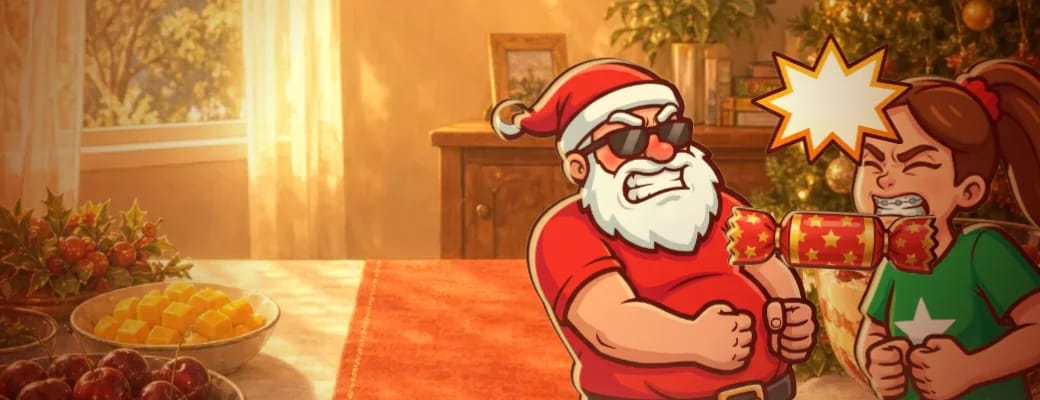
A Christmas bon bon is what most Australians call a Christmas cracker: a cardboard tube wrapped in bright paper, twisted at both ends, that two people pull apart until it goes off with a snap. Whoever ends up with the bigger half keeps what's inside, traditionally a folded paper crown, a small toy and a joke bad enough to make the whole table groan.
They're a fixture of the Australian Christmas lunch table, usually one per place setting. Here's where they came from, how the snap works, and why Australians call them bon bons when the British call them crackers.
What's inside a bon bon
Pull one and you'll usually find:
- A paper crown. Thin tissue paper, folded into a strip, that opens out into a crown. Tradition says you wear it for the whole meal, even in 35-degree heat, even when it sticks to your forehead.
- A small gift. Classics include a plastic puzzle, a tiny comb, a spinning top, a measuring tape or a fortune-telling fish. Fancy bon bons have better gifts; cheap ones have a mystery.
- A joke or motto. Short, punny and terrible, read out loud to the table. The worse the better.
- The snap. A thin strip that cracks when the bon bon is pulled apart (more on that below).
The basic contents have barely changed in more than a century. Tom Smith & Co.'s 1907 Christmas Tree Crackers promised "toys, flags, jewels, hats, caps and children's mottoes" [2].
Where bon bons came from: a London sweet shop
The cracker is a Victorian London invention. The person usually credited is Tom Smith (1823 to 1869), a confectioner and baker who opened a shop on Goswell Road, Clerkenwell, in the 1840s, making wedding cakes and sweets [1].
On a trip to Paris, Smith came across the French bon bon: a sugared almond wrapped in a twist of tissue paper [1]. He started selling his own, and to keep people buying outside the Christmas rush he tucked a small love motto inside the wrapper [1]. The UK's National Archives describes him wrapping paper mottoes into his bonbon sweets in the 1840s [2].
The bang came next. According to the V&A, the idea of a "pop" was supposedly sparked by the crackle of a log fire; Smith patented his first cracker device in 1847 and perfected the mechanism in the 1860s [1]. (The word "supposedly" is doing honest work there: like most good origin stories, this one has probably been polished in the retelling.)
With the snap added, the bon bon had become a cracker. Tom's son Walter Smith later added the elaborate paper hats and sourced small gifts from Europe, America and Japan [1]. Tom Smith & Co. went on to become the leading cracker maker and was granted a Royal Warrant [2]. The V&A holds illustrated Tom Smith catalogues and early crackers in its collection [1].
How does a bon bon snap?
Inside every bon bon are two narrow strips of card that overlap along the tube. One strip carries a tiny amount of silver fulminate; the other has a rough, abrasive surface [1]. When you pull the bon bon apart, the strips slide against each other, and the friction sets off the silver fulminate with a small, sharp crack [1] [4].
Silver fulminate is an extremely sensitive compound. Chemistry educator Andy Brunning explains that in quantities of more than a few milligrams it can set itself off under its own weight, which is why a snap uses only a minute amount [4]. It's touchy because a weak nitrogen-oxygen bond in the fulminate ion gives way easily, and the compound breaks down into nitrogen gas, carbon dioxide and more stable metal salts [4]. The "bang" you hear is that very small, very fast reaction.
That's also why a bon bon only goes off once, and why it's polite not to pull one right next to someone's ear.
Why do Australians say "bon bon"?
The thing in the box is the same; the name depends on where you are. In Britain it's a Christmas cracker. In Australia it's mostly a bon bon, and Australian museum collections record them that way: the History Trust of South Australia describes a mid-century box as containing "12 Christmas crackers or bon bons" [3].
We couldn't find a solid record of exactly when or why the Australian name stuck, but the history gives a good clue. The cracker began life as Tom Smith's bonbon, a wrapped sweet with a motto [1] [2]. In Britain, the newer name for the noisy version, "cracker", won out. In Australia, the older name for the twisted paper parcel hung on. If you're from overseas and an Aussie offers you "the other end of my bon bon", that's what they mean: grab hold and pull.
A few useful bits of bon bon etiquette:
- Cross arms. At a big table everyone crosses arms and pulls with both neighbours at once.
- Bigger end wins. The person left holding the end with the goodies keeps them.
- Crowns on. Everyone wears their crown, including the person who says they're too old for it.
- Read the joke out. Mandatory, especially when it's bad.
Some bon bon jokes (ours, clean, Aussie)
Bon bon jokes are meant to be terrible. We wrote these ourselves, and we're sorry.
- Why did Santa swap the sleigh for a ute? It had better air con.
- What do you call a kangaroo at the North Pole? Lost.
- Why don't prawns share their Christmas presents? Because they're shellfish.
- What's a koala's favourite Christmas carol? Silent Night. It sleeps through the rest.
- What did the pavlova say to Nan? Don't crack under pressure.
- Why was the bin chicken invited to Christmas lunch? It promised to clean up afterwards.
- What do you call Santa after a day at the beach without his hat? Sunburnt Santa. Slip, Slop, Slap, mate.
Play it: Bon Bon Snap
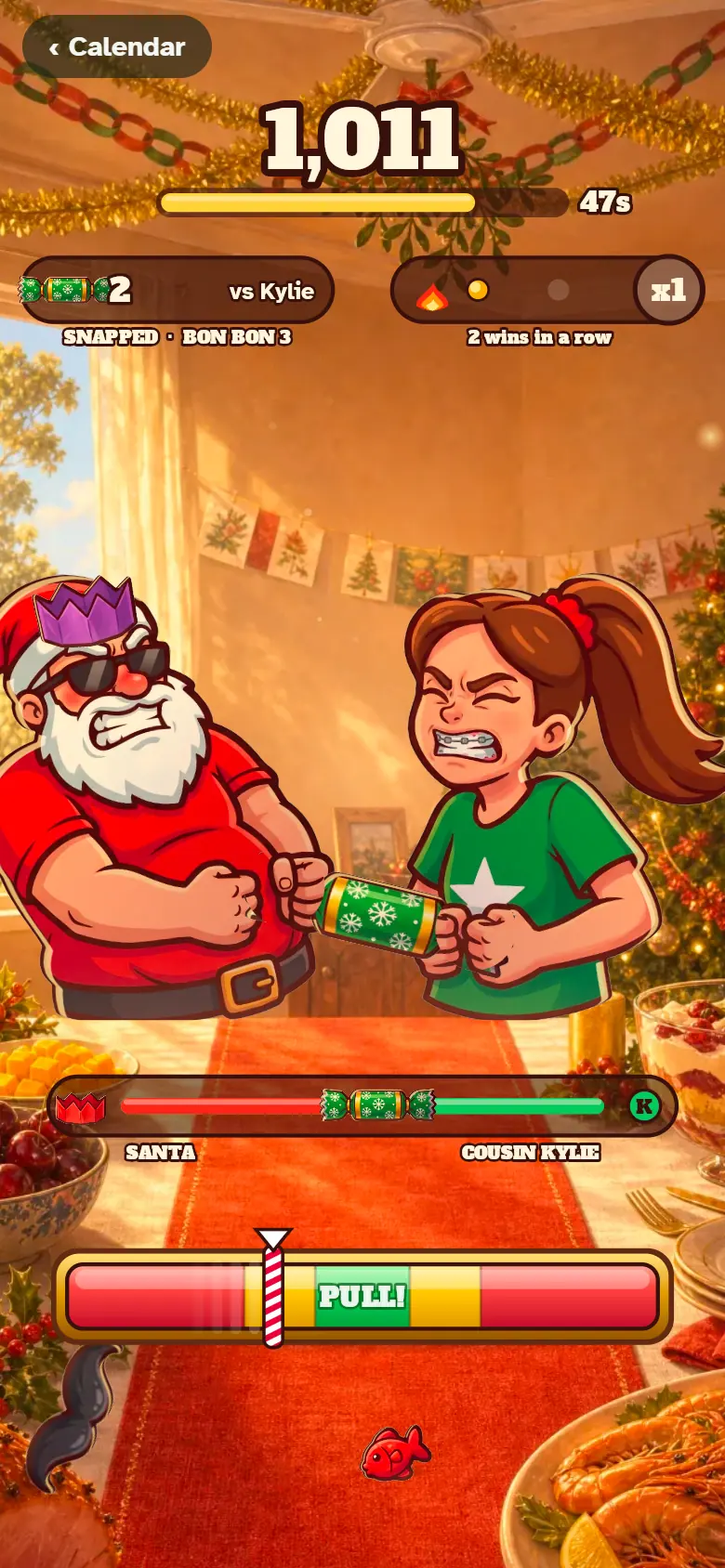
The bon bon pull is serious business in plenty of Aussie houses, so it got its own game. In Bon Bon Snap, Door 10 of Sunburnt Santa, a bar sweeps under the bon bon and you tap when it's in the green for a big pull; yellow is a small one, and red lets the other side pull back. You take on Nan, Uncle Bazza, Cousin Kylie and Digger the dog, each with their own rhythm, and the bar gets quicker every bon bon. Snap it on your side for 300 points plus a speed bonus, and string wins together to multiply your score. Cousin Kylie famously never loses a bon bon; you can meet the whole family on the characters page, and the rest of the day is in our guide to Christmas in Australia.
Keep reading
Sources
- The Christmas cracker, Victoria and Albert Museum
- Tom Smith's Christmas crackers, The National Archives (UK)
- Box of Christmas Crackers (HT 2022.0034), History Trust of South Australia
- Christmas Chemistry: the chemistry of Christmas crackers, Compound Interest (Andy Brunning)