Why is Christmas in summer in Australia?
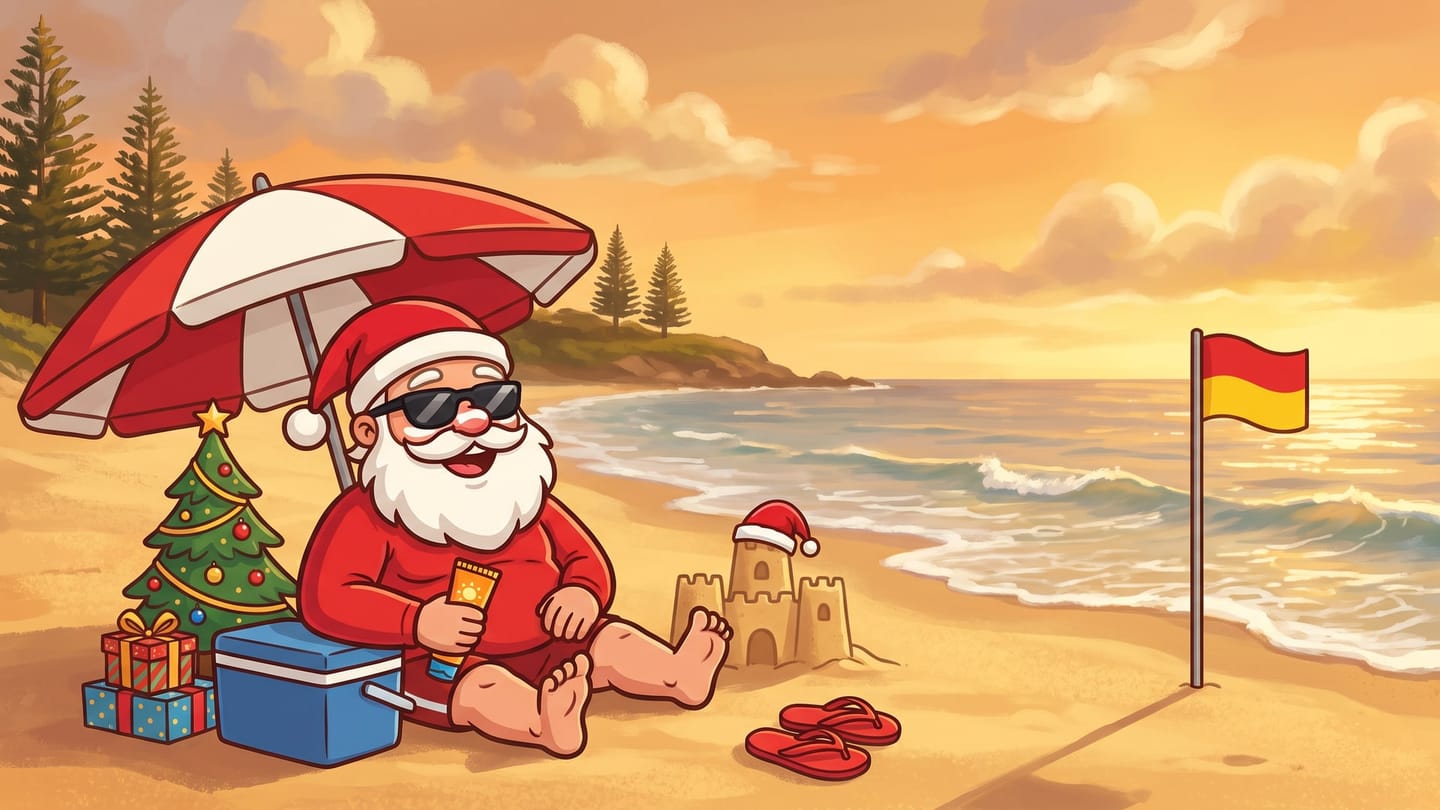
Christmas is in summer in Australia because Australia is in the southern hemisphere, and in December the southern half of the Earth is tilted towards the Sun. The date of Christmas is the same everywhere, 25 December, but the seasons are flipped, so the same day that brings snow to London brings beach weather to Sydney.
That's the short version. Here is the longer one: what the tilt actually does, how hot it really gets in each capital city, and how a winter festival ended up being celebrated in board shorts.
It's the tilt, not the distance
Earth spins on an axis tilted about 23.5 degrees from the plane of its orbit around the Sun [1]. That axis always points the same way in space, so as Earth travels around the Sun over a year, first one hemisphere and then the other leans towards it [1].
When the southern hemisphere leans towards the Sun, two things happen. The Sun climbs higher in the sky at midday, so its light hits the ground more directly and heats it more, and the days get longer, so there are more hours of heating [1]. That is summer. Six months later the southern hemisphere leans away, the Sun sits lower and the days are short: winter.
Around 22 December the Sun is directly over the Tropic of Capricorn, which crosses Queensland, the Northern Territory and Western Australia. That is the southern hemisphere's summer solstice and the longest day of the year [1]. Christmas comes three days later.
A common guess is that Australia is simply closer to the Sun in December. Earth's orbit isn't a perfect circle, but the difference in distance is small compared to the whole distance, and Earth is actually closest to the Sun in early January, during the northern winter [2]. If distance drove the seasons, the whole planet would have summer at once. It doesn't, which is the giveaway.
How long are Christmas days?
Because of the tilt, the further south you are, the bigger the swing. Hobart gets about 15 hours of daylight at the summer solstice and only about 9 at the winter solstice, while Darwin, much closer to the equator, varies only between about 11.5 and 12.5 hours [1]. So a Tasmanian Christmas comes with long, light evenings, and a Top End one gets dark at much the same time it does all year.
Why late January is often hotter than Christmas
The solstice isn't the hottest time of year. The oceans around Australia store heat and release it slowly, so across much of southern Australia the warmest week typically comes in late January or early February, some weeks after the solstice [1]. Christmas is hot, but it is usually the start of the heat, not the peak.
How hot is Christmas in Australia? December in every capital
These are Bureau of Meteorology long-term December averages for one main weather station in each capital, plus Cairns for the tropical north. The years of record differ from station to station (Sydney's long Observatory Hill series runs to 2020, Melbourne's Olympic Park record starts in 2013), so treat them as a guide to what's typical, not a forecast.
| City (station) | Mean max | Mean min | Mean rainfall |
|---|---|---|---|
| Darwin (Airport) [3] | 32.8 °C | 25.4 °C | 255.5 mm |
| Cairns (Aero) [11] | 31.5 °C | 23.4 °C | 193.8 mm |
| Brisbane [4] | 29.7 °C | 20.6 °C | 137.9 mm |
| Perth (Metro) [5] | 29.6 °C | 16.6 °C | 9.6 mm |
| Canberra (Airport) [6] | 27.4 °C | 11.9 °C | 75.2 mm |
| Adelaide (West Terrace) [7] | 26.9 °C | 15.1 °C | 25.9 mm |
| Sydney (Observatory Hill) [8] | 25.3 °C | 17.6 °C | 77.1 mm |
| Melbourne (Olympic Park) [9] | 24.7 °C | 14.4 °C | 50.2 mm |
| Hobart (Ellerslie Road) [10] | 20.4 °C | 10.9 °C | 56.6 mm |
A few things jump out:
- Averages hide the scorchers. A mean maximum is just that, an average: any one Christmas Day can be far hotter, or cooler and wetter, than the number in the table.
- The north is wet, not just hot. December is the start of the wet season in the tropics. Cairns averages about 194 mm in December and more than 400 mm in each of January, February and March [11]. Darwin's December nights average above 25 °C [3].
- Perth is the driest Christmas. Less than 10 mm of December rain on average [5], so a Perth Christmas almost always means blue sky.
- Canberra has the biggest day-to-night swing, from about 27 °C in the afternoon to about 12 °C overnight [6]. Bring a jumper for the carols.
How a winter festival ended up on the beach
Christmas is on 25 December everywhere, a date settled in Europe, in the northern hemisphere, long before Europeans reached Australia. So many of the things the world thinks of as "Christmassy" are really northern-winter things: snow, fir trees, roaring fires, heavy roast dinners and puddings. Even the Christmas cracker was a Victorian London invention; the V&A says Tom Smith's snap was supposedly inspired by the crackle of a log fire [12], not something you'd light in a Brisbane December.
British colonists brought those winter customs with them. Over time the day has been reshaped to fit the weather: cold seafood and salads alongside (or instead of) the roast, pavlova and summer fruit, a swim, backyard cricket in the afternoon. Australia has also built traditions of its own. Melbourne's Carols by Candlelight, an outdoor summer-night concert, began in 1938 and has been held at the Sidney Myer Music Bowl since 1959 [13].
The land had its own way of reading the year long before any of this. The Nyoongar seasonal calendar of south-west Western Australia, hosted by the Bureau of Meteorology, has six seasons; December and January fall in Birak, the first summer, when the rains ease and afternoon sea breezes arrive [14]. The four European seasons are a fairly blunt tool for a continent this size; the Nyoongar calendar reads the seasons from what is flowering, nesting and moulting rather than from dates [14].
Who else has Christmas in summer?
Australia isn't alone. Countries south of the equator, from New Zealand to South Africa and Argentina, have Christmas in summer for the same reason, and each has its own way of celebrating it. We've rounded them up in countries where Christmas is in summer.
Stay sun-safe this Christmas
"Sunburnt Santa" is a joke, not a goal. A summer Christmas means a lot of time outdoors in strong sun, so follow the Cancer Council's five steps: slip on a shirt, slop on sunscreen, slap on a hat, seek shade and slide on wraparound sunglasses [15].
Play it: Hot Sand Sprint
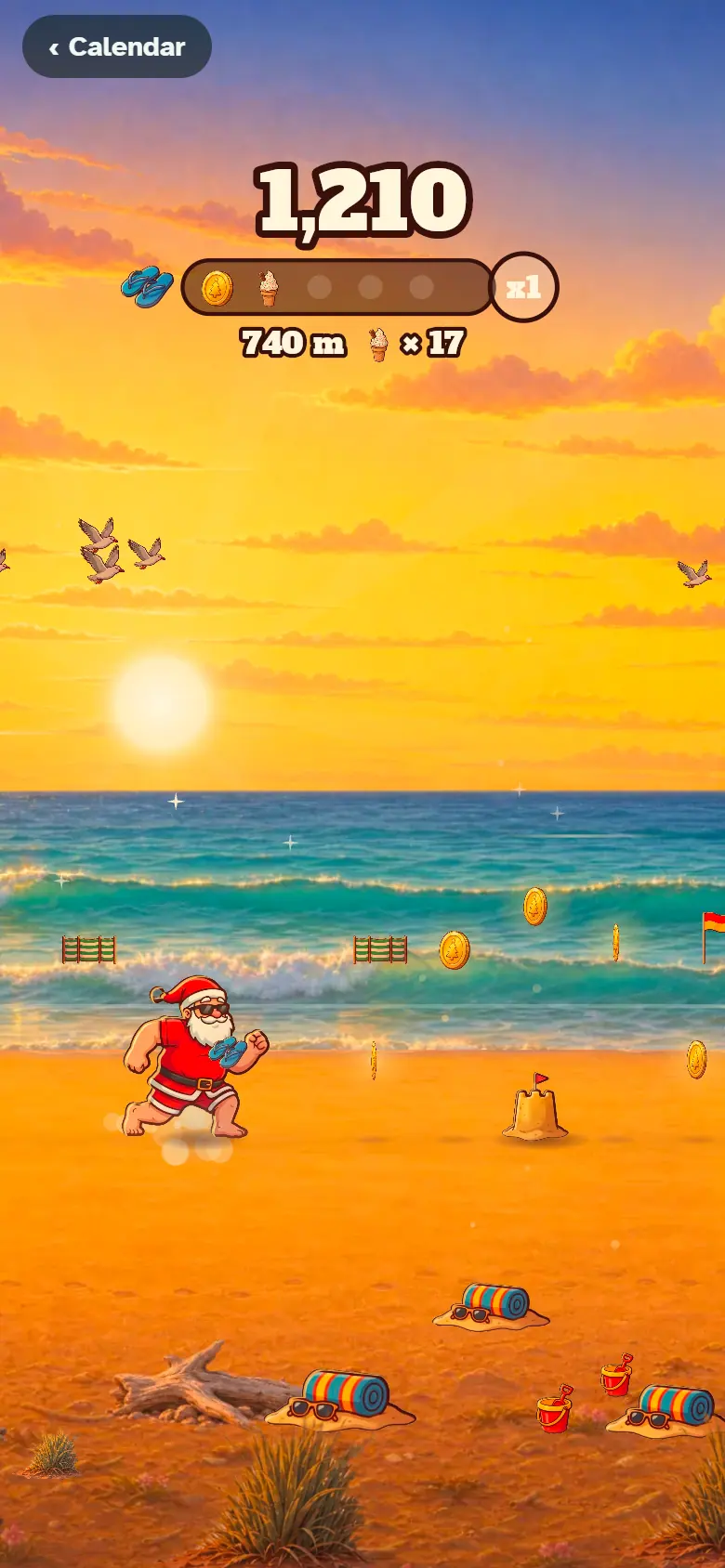
If you have ever crossed a car park in thongs (flip-flops) in December, or lost them and crossed it barefoot, you will recognise Hot Sand Sprint, Door 7 of Sunburnt Santa. Santa is barefoot on the beach, so you jump the patches of hot sand, the mud crabs and the sandcastles, keep low under the seagulls, and grab a pair of thongs to forgive your next hot-sand patch. It is one of 24 Aussie Christmas mini-games in our free advent calendar game, and there is more about the season itself in our complete guide to Christmas in Australia.
Keep reading
Sources
- Solstices, equinoxes and the seasons, Bureau of Meteorology
- What causes the seasons?, NASA Space Place
- Summary statistics, Darwin Airport (station 014015), Bureau of Meteorology
- Summary statistics, Brisbane (station 040913), Bureau of Meteorology
- Summary statistics, Perth Metro (station 009225), Bureau of Meteorology
- Summary statistics, Canberra Airport (station 070351), Bureau of Meteorology
- Summary statistics, Adelaide (West Terrace / ngayirdapira) (station 023000), Bureau of Meteorology
- Summary statistics, Sydney (Observatory Hill) (station 066062), Bureau of Meteorology
- Summary statistics, Melbourne (Olympic Park) (station 086338), Bureau of Meteorology
- Summary statistics, Hobart (Ellerslie Road) (station 094029), Bureau of Meteorology
- Summary statistics, Cairns Aero (station 031011), Bureau of Meteorology
- The Christmas cracker, Victoria and Albert Museum
- Our history, Vision Australia's Carols by Candlelight
- Nyoongar calendar, Bureau of Meteorology
- Slip, Slop, Slap, Seek, Slide, Cancer Council Australia