Countries where Christmas is in summer
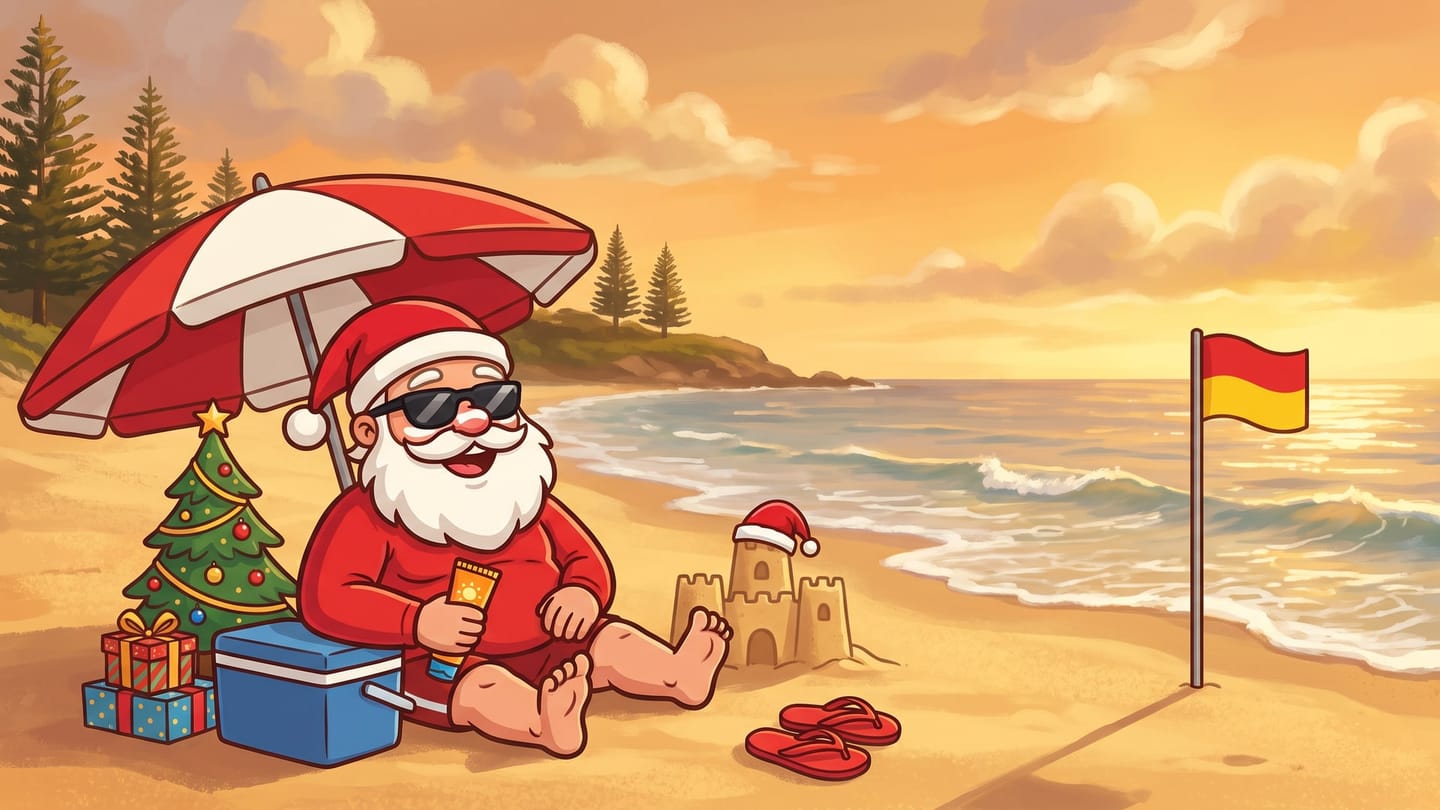
Christmas falls in summer in the countries of the Southern Hemisphere that sit outside the tropics: Australia, New Zealand, South Africa, Argentina, Chile, Uruguay, Paraguay, southern Brazil and neighbours such as Lesotho and Eswatini. Closer to the equator, in places like Darwin, Fiji, Samoa or Rio de Janeiro, December is less "summer" than hot and wet, because the tropics run on wet and dry seasons rather than four clear ones.
So "summer Christmas" covers more of the world than most northern readers expect, and it isn't one experience. A Christmas lunch in Hobart, a midnight feast in Buenos Aires and a church service in a downpour in Suva are all summer Christmases.
Why is Christmas in summer south of the equator?
Because the Earth is tilted. Its axis leans about 23.4 degrees from upright compared with its path around the Sun [2], and that tilt causes the seasons [1]. In December the Southern Hemisphere leans towards the Sun: sunlight hits it more directly and days are longer, so it's summer. The Northern Hemisphere leans away and gets winter. As NASA puts it, the two hemispheres have "opposite timing for the seasons" [1].
It's not about distance. The Earth is actually closest to the Sun in early January, during the northern winter [1]. The difference between the nearest and farthest points of the orbit (about 147 million and 152 million kilometres) [2] is too small to matter much for the weather [1].
There's a fuller explainer, with the Aussie angle, in why Christmas is in summer in Australia.
Southern Hemisphere vs the tropics
Being south of the equator doesn't automatically mean a hot, dry, beachy Christmas.
- The mid-latitudes (roughly southern Australia, New Zealand, South Africa, Argentina, Chile, Uruguay) have four seasons, and December is early summer: long days, warm to hot, often dry.
- The tropics (between the equator and the Tropic of Capricorn) are warm all year. What changes is the rain. Australia's Bureau of Meteorology treats the north's wet season as officially running from 1 October to 30 April, with the dry season from May to September [3]. So a Christmas in Darwin, Cairns, Suva or Apia is usually humid, stormy and green.
The numbers below show it. Perth and Santiago get almost no December rain; Darwin, Suva and Apia get more than 250 mm. Lima is an odd one out: it sits in the tropics but is a coastal desert, mild and almost rainless in December.
How hot is Christmas? December averages
Long-term December averages from the World Meteorological Organization's World Weather Information Service, which publishes each country's official climate normals [4]. These are monthly averages, not Christmas Day records, and some normals are older than others (period shown).
| City | Country | Avg max (°C) | Avg min (°C) | Dec rain (mm) | Period |
|---|---|---|---|---|---|
| Darwin | Australia | 32.7 | 25.6 | 276 | 1981–2010 |
| Brisbane | Australia | 29.3 | 20.3 | 133 | 1999–2015 |
| Perth | Australia | 28.8 | 16.2 | 6 | 1994–2010 |
| Adelaide | Australia | 26.9 | 15.5 | 30 | 1981–2010 |
| Sydney | Australia | 25.5 | 18.3 | 79 | 1981–2010 |
| Melbourne | Australia | 24.4 | 14.1 | 63 | 1981–2010 |
| Hobart | Australia | 20.4 | 11.3 | 57 | 1981–2010 |
| Auckland | New Zealand | 21.8 | 14.9 | 87 | 1981–2010 |
| Christchurch | New Zealand | 21.1 | 10.5 | 47 | 1981–2010 |
| Wellington | New Zealand | 19.6 | 13.5 | 65 | 1981–2010 |
| Durban | South Africa | 26.9 | 20.0 | 102 | 1961–1990 |
| Johannesburg | South Africa | 25.2 | 13.9 | 105 | 1961–1990 |
| Cape Town | South Africa | 24.9 | 14.9 | 17 | 1961–1990 |
| Windhoek | Namibia | 31.4 | 17.2 | 31 | 1961–1990 |
| Harare | Zimbabwe | 26.3 | 15.8 | 183 | 1961–1990 |
| Asunción | Paraguay | 32.3 | 21.8 | 150 | 1971–2000 |
| Santiago | Chile | 28.8 | 12.2 | 2 | 1981–2010 |
| Buenos Aires | Argentina | 28.5 | 18.4 | 119 | 1981–2010 |
| Rio de Janeiro | Brazil | 28.6 | 22.4 | 169 | 1961–1990 |
| Montevideo | Uruguay | 26.5 | 16.3 | 84 | not stated |
| São Paulo | Brazil | 26.3 | 17.7 | 201 | 1961–1990 |
| Lima | Peru | 23.9 | 17.7 | 0.3 | not stated |
| Apia | Samoa | 30.5 | 23.8 | 358 | 1971–2000 |
| Suva | Fiji | 29.8 | 23.2 | 263 | 1961–1990 |
A few things jump out. Hobart and Wellington have a mild Christmas, around 20 degrees, which surprises people who picture every southern Christmas as a scorcher. Asunción and Darwin are the hottest in the list. And the dry, sunny "barbie and beach" Christmas is most reliable in places like Perth, Adelaide, Santiago and Cape Town.
How each country celebrates
Australia
Christmas lunch outdoors, prawns and pavlova, backyard cricket and a swim are all part of it, and the big shared event is carols. Carols by Candlelight began in Melbourne in 1938, founded by radio broadcaster Norman Banks, and drew about 10,000 people to the Alexandra Gardens; since 1959 it has been held at the Sidney Myer Music Bowl [5]. Our complete guide to Christmas in Australia covers the rest.
New Zealand
New Zealand has its own Christmas tree: the pōhutukawa, which covers itself in red flowers around Christmas [6]. In Māori legend the red flowers are the blood of the warrior Tāwhaki [6]. Kiwis call their thongs (flip-flops) jandals, and on Christmas Day plenty of them are wearing a pair.
South Africa
25 December is Christmas Day and 26 December is the Day of Goodwill, both public holidays [8]. Many South Africans now have a braai (barbecue) on Christmas Day instead of a formal sit-down lunch, and at the coast seafood on the braai is a favourite [7].
Argentina
The main event is Christmas Eve. December temperatures usually go above 30 degrees, the dinner is big, and presents are opened just after midnight, when Papá Noel is supposed to have delivered them [9]. Pan dulce, Argentina's version of panettone, comes out at midnight. Midnight fireworks are traditional, though the Buenos Aires Herald notes the custom is fading out of consideration for autistic people and pets [9].
Brazil
The Missa do Galo (the "rooster's Mass") at midnight is considered the main Christmas Mass in Brazil's Catholic tradition [10], and the ceia de Natal, the Christmas Eve supper, is shared late at night with family, with dishes such as rice, farofa, chicken and cheeses and plenty of fruit on the table [11]. In the south, Christmas is summer; in Rio it's hot and wet.
Chile
Chileans call Santa the Viejito Pascuero, and the Christmas fruit loaf is pan de Pascua, a relative of the Italian panettone and German stollen [12]. Santiago's December is hot and almost dry.
Uruguay
In Uruguay, a law from 1919 lists 25 December as the Día de la Familia, Family Day [13]: Christmas Day by another name.
Paraguay
The nativity scene (pesebre) is the heart of a Paraguayan Christmas, and it must have flor de coco, the flower of the mbokaja palm. As one historian put it, a pesebre without flor de coco isn't a Paraguayan pesebre [14]. Families start setting up the pesebre after 8 December, the feast of the Virgin of Caacupé [14].
Peru
Peru is in the tropics, but Lima's Christmas is mild and dry. Panetón (panettone) with hot chocolate is one of the most recognisable symbols of a Peruvian Christmas; there are more than a thousand registered panetón brands [15].
Bolivia
In Bolivia, picana, a hearty Christmas stew, is the traditional dish served at midnight on Christmas Eve after the arrival of the Christ Child, and the leftovers come back for lunch on the 25th [16]. La Paz sits so high in the Andes that a Christmas there is cool rather than summery.
Fiji and the Pacific
Fiji's Christmas is about family get-togethers, church and carolling, with food cooked in the lovo, an underground oven of hot stones; many families stretch Christmas and New Year into a month-long celebration [17]. December is wet in the tropical Pacific: Suva and Apia both average more than 250 mm of rain in the month [4].
Sun-smart at a summer Christmas
In Australia "sunburnt" is the joke, not the plan. Cancer Council's advice has been the same since 1981, updated in 2007 to five steps: Slip on a shirt, Slop on sunscreen, Slap on a hat, Seek shade and Slide on sunglasses [18]. It works for a beach Christmas in Durban or Mar del Plata too.
Play a summer Christmas
Sunburnt Santa is built around the Aussie version of all this. In Sandy Claus you stack sand blocks to build a sand Santa before the tide comes in, and in Hot Sand Sprint Santa runs barefoot along the beach, jumping hot sand, mud crabs and sandcastles while the seagulls swoop. Both are doors in a free advent calendar game, so you can have a summer Christmas wherever you are.
Keep reading
- Why is Christmas in summer in Australia?
- Christmas traditions around the world: 35 countries, region by region
- Christmas in Australia: the complete guide
Sources
- What Causes the Seasons?, NASA Space Place
- Earth Fact Sheet, NASA Space Science Data Coordinated Archive
- Tropical Climate Update, Bureau of Meteorology
- World Weather Information Service: official city climate normals (Sydney, Melbourne, Brisbane, Perth, Adelaide, Hobart, Darwin, Auckland, Wellington, Christchurch, Cape Town, Johannesburg, Durban, Windhoek, Harare, Buenos Aires, Santiago, Montevideo, Asunción, São Paulo, Rio de Janeiro, Lima, Suva, Apia), World Meteorological Organization, with each country's national meteorological service
- Our history, Vision Australia's Carols by Candlelight
- Pōhutukawa, Department of Conservation (New Zealand)
- South African Christmas dinner traditions, The Citizen
- Public holidays, South African Government
- I'm dreaming of an Argentine Christmas, Buenos Aires Herald
- Confira a programação especial de Natal nos veículos da EBC, Agência Brasil (EBC)
- Ceia das festas de fim de ano contam com alimentos especiais produzidos pela agricultura familiar, Ministério do Desenvolvimento Agrário e Agricultura Familiar, Government of Brazil
- Pan de pascua, el pesebre, viejo pascuero: el origen de las tradiciones navideñas, La Tercera
- Ley N° 6997 (1919), IMPO, Uruguay's official legal database
- Símbolo de la cultura guaraní: 'La Navidad en Paraguay sin flor de coco no tendría sentido', Última Hora
- Panetón y chocolate caliente: tradición peruana que también se protege con marca registrada, El Peruano
- La picana de nochebuena, Los Tiempos
- Christmas in the true Fijian style, The Fiji Times
- Slip, Slop, Slap, Seek, Slide, Cancer Council Australia