Cassowary crossing signs: Christmas driving in Far North Queensland
A cassowary crossing sign means endangered southern cassowaries live in the forest beside the road and walk across it, so you should slow down and expect one around the next bend. The Queensland Government's advice is simple: slow down in cassowary habitat, never stop on the road to look at one, and keep an eye out for the bright yellow "Recent Cassowary Crossing" signs [2].
If you're driving to Mission Beach, the Daintree or the Atherton Tablelands this summer, here's what the signs are asking of you, and why a few kilometres an hour matter so much.
What is a cassowary?
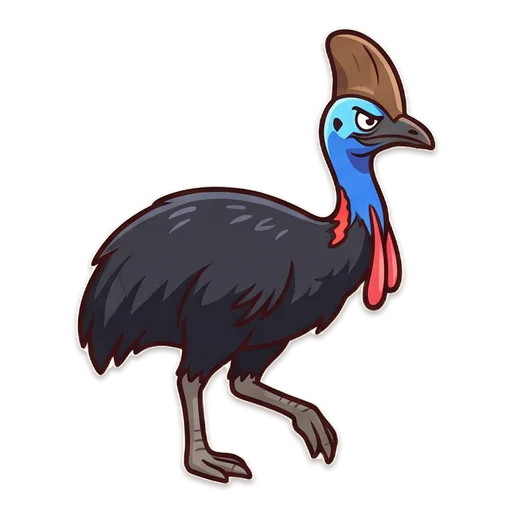
The southern cassowary (Casuarius casuarius) is a huge, flightless rainforest bird, 150 to 200 cm, with black, hair-like feathers, bare blue skin on its head and fore-neck, a red rear neck and wattle, and a big greyish helmet called a casque [4]. In Australia it lives only in northern Queensland [4]. It mostly eats fallen fruit, along with snails, fungi and small dead animals [4].
Cassowary family life runs backwards from what you might expect. The female lays a clutch of about four large green eggs and leaves; the male incubates them and raises the chicks, striped yellow and black, on his own [4]. Breeding runs from June to October [4], so by the summer holidays you may well see a father walking with half-grown chicks behind him.
How endangered is it?
The southern cassowary is listed as Endangered under the Commonwealth Environment Protection and Biodiversity Conservation Act 1999. Under Queensland's Nature Conservation Act 1992 the Wet Tropics population is listed as Endangered and the Cape York populations as Vulnerable [3].
There are three populations left in Australia: one in the Wet Tropics and two on Cape York [1]. A 2014 CSIRO survey estimated up to 4,400 cassowaries in the Wet Tropics [1]. Their Wet Tropics range runs from Cooktown to just north of Townsville, with core habitat in the coastal lowlands between Ingham and Mossman and in the uplands of the southern Atherton Tablelands [3].
The Queensland Government lists the main threats as habitat loss and fragmentation, vehicle strikes, introduced predators such as pigs and dogs, attacks by domestic dogs, and extreme weather such as cyclones [1]. The federal recovery plan names roads and traffic directly: "cassowaries are killed by vehicles on roads", and hand feeding makes it worse by bringing cassowaries closer to traffic and dogs [3].
Why the signs matter around Mission Beach
Mission Beach, south of Cairns, supports the highest density of cassowaries in Australia, according to the local conservation group Mission Beach Cassowaries, which calls the area "The Slow Down Town" [5]. The group says cassowaries have died on the roads there at an average rate of four a year at Mission Beach alone, and that road kills are the number one cause of death for adult cassowaries [5]. With a population counted in the low thousands, that's a lot of birds.
The cassowary also matters to the Djiru Traditional Owners of the Mission Beach area, for whom it is important to culture and community identity [5].
What to do when you see the sign
These come from the Queensland Government's Be Cass-o-wary safety tips [2] and its southern cassowary page [1]:
| On the road | Why |
|---|---|
| Slow down whenever you're in cassowary habitat | Cassowaries can step out unexpectedly [2] |
| Watch for chicks following an adult | Young birds are smaller and harder to spot [2] |
| If one is on or near the road, reduce speed, avoid it and warn other drivers | Give it room to cross [2] |
| Never stop on the road to look at a cassowary | Slow down, avoid it and keep moving instead [1] [2] |
| Never feed a cassowary | It's illegal and dangerous, fines apply, and feeding beside roads raises the risk of collisions [1] [2] |
The Mission Beach group adds some local courtesy: drive expecting a cassowary over the next crest, flash a warning to oncoming drivers if you see one near the road, and be patient with cars that have slowed for a crossing rather than overtaking them [5].
If you meet one on foot
Cassowaries can be dangerous when they feel cornered, and fathers defend their chicks [1]. The Queensland Government's advice if one comes towards you [2]:
- Stay calm, face the bird and never turn your back.
- Back away slowly.
- Put something between you and the bird, such as a tree or a backpack.
- Hide food and drinks, and put your phone away; cassowaries may mistake it for food.
- Never approach an adult or a chick, and never get between a chick and its father [1].
- Keep dogs in the yard, and on a leash when you walk them [2].
Report it
If a person is hurt by a cassowary, call 000. For an injured or orphaned cassowary, the Queensland Government asks you to call 1300 130 372 (option 1, then option 2) and leave a detailed location if nobody answers, without approaching or moving the bird [2]. Sightings can be logged in the free QWildlife app [1].
Christmas holidays in cassowary country
December is when a lot of us hit the road: family visits, a week at the beach, a first look at the rainforest. In Far North Queensland that often means unfamiliar, winding roads through the very habitat the signs are protecting, sometimes in summer rain, sometimes with a car full of tired kids. Leaving ten minutes earlier so you're not in a hurry is the easiest gift you can give a cassowary.
Sunburnt Santa is made in Yungaburra, on the Atherton Tablelands, where cassowary signs are part of the scenery. The Queensland Government lists an Atherton Tablelands cassowary rehabilitation facility at Lake Barrine among the places that care for injured and orphaned birds [1].
Play it: Cassowary Crossing
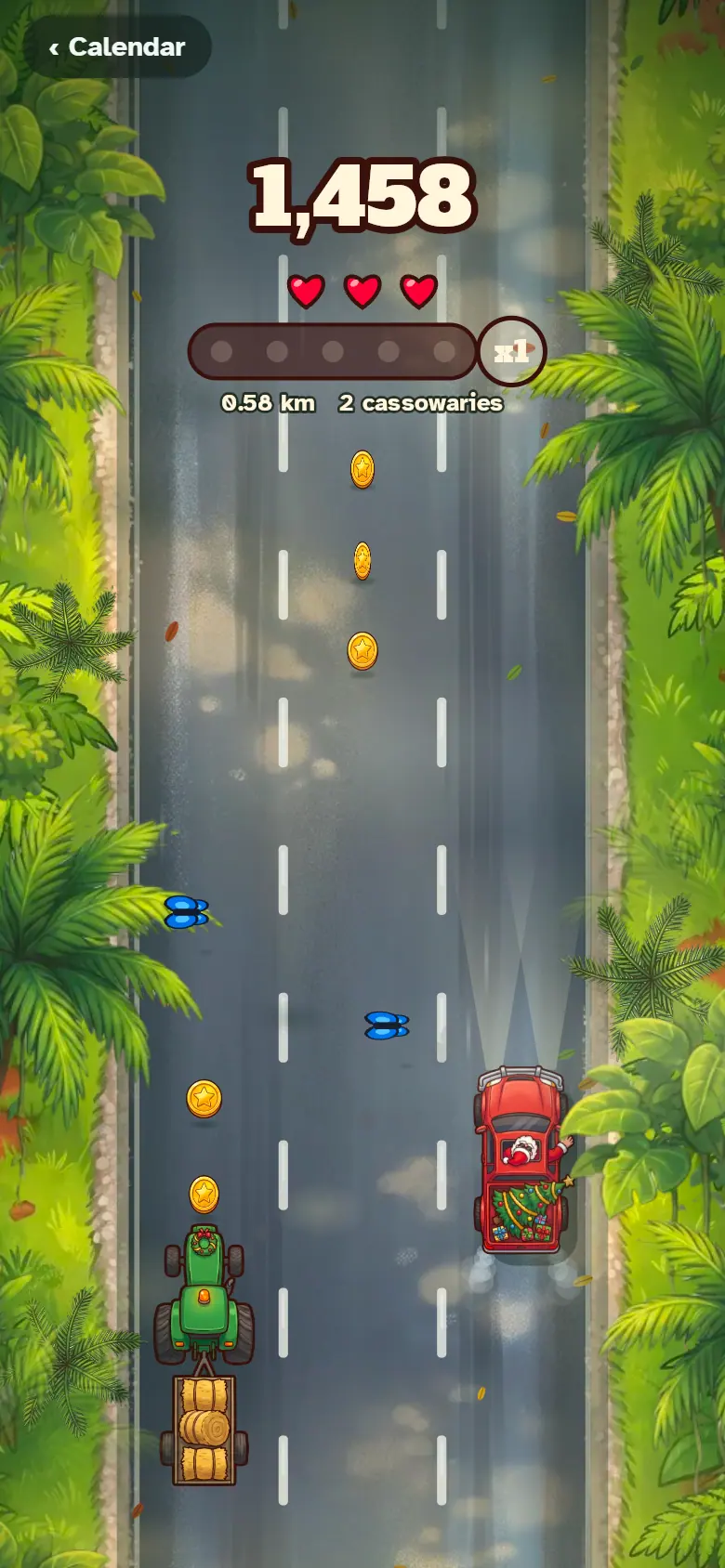
Door 13 puts you behind the wheel of Santa's ute on a Far North Queensland road. In Cassowary Crossing, cassowaries wait at the roadside and then walk across, and your job is to read which way each one is heading and move into the lane it has just left. Every cassowary that crosses safely is worth 150 points, and getting it wrong costs two of your three hearts, so the game rewards exactly what the real signs ask for: slow your thinking down and give the bird the road. You'll also dodge potholes, cane toads, wallabies, a slow tractor and a cow on the cattle grid. Cassowaries come back on the last night of the advent calendar game, standing by the road in Christmas Eve Run.
Keep reading
- Christmas in Australia: the complete guide
- Why do cockatoos rip off Christmas lights?
- Bin chickens: why Australians call the ibis a bin chicken
Sources
- Southern cassowary, Queensland Government
- Be Cass-o-wary safety tips, Queensland Government
- Recovery plan for the southern cassowary (Casuarius casuarius johnsonii), Australian Government Department of Climate Change, Energy, the Environment and Water
- Southern Cassowary, Australian Museum
- About cassowaries, Mission Beach Cassowaries Inc (community conservation group)