Christmas traditions around the world: 35 countries, region by region
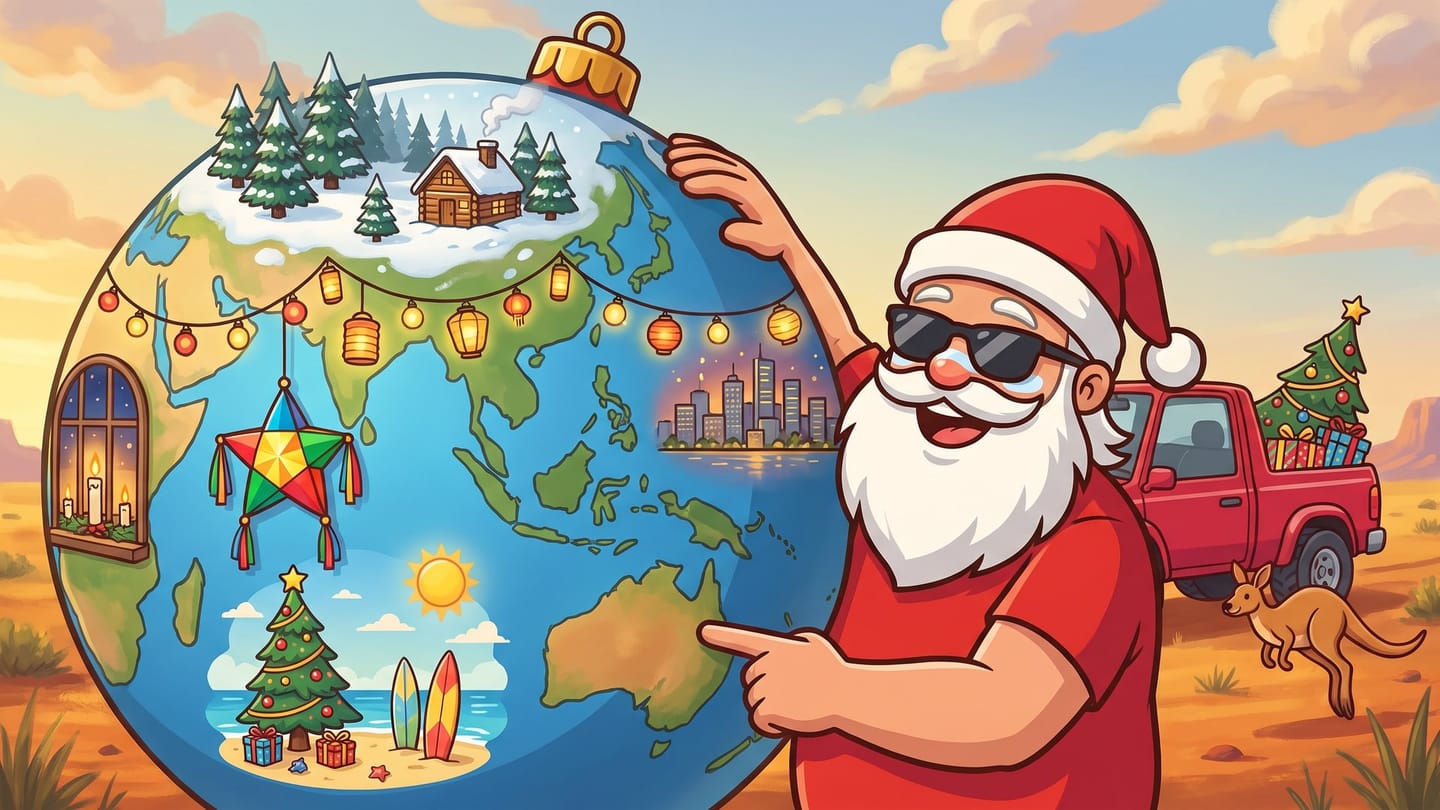
Christmas traditions around the world share a core (church services, a family meal, gifts, lights and a gift-bringer who may or may not be Santa) but the details change completely from country to country. In Iceland 13 troll brothers leave gifts in children's shoes, in Mexico the nine nights before Christmas are posadas, in Ethiopia Christmas is on 7 January, and in Australia it's 30-something degrees and lunch is on the barbie.
Below are 35 countries, grouped by region, with one short paragraph each on what makes their Christmas distinctive. Every tradition is checked against a tourism body, government, museum, university or national news source, listed at the bottom.
Before you start: two dates and many faiths
25 December or 7 January? Most churches celebrate Christmas on 25 December. Several Eastern churches keep the older Julian calendar, which runs behind the Gregorian calendar used for everyday dates, so their 25 December falls on 7 January. That includes the Russian Orthodox Church [20], the Ethiopian Orthodox Church [28] and Egypt's Coptic Orthodox Church [29]. Ukraine moved its official Christmas holiday from 7 January to 25 December in 2023 [19].
Not everyone celebrates. Christmas is a Christian festival, and in many countries on this list Christians are a minority. Japan is a good example: only about 1% of people identify as Christian, and Christmas there is mostly a secular season of lights, cake and dates [34]. Where a tradition is religious we say so; where it's cultural, we say that too.
Europe
United Kingdom
Two things define a British Christmas Day afternoon. One is the monarch's Christmas Broadcast, which began with King George V on the radio from Sandringham in 1932; the first televised message came in 1957 [1]. The other is the cracker: a paper tube that two people pull until it snaps. London confectioner Tom Smith, inspired by French sugared almonds wrapped in paper, patented his first cracker device in 1847, the snap was perfected in the 1860s, and his son Walter added the paper hats [2]. Australians call them bon bons.
Ireland
On Christmas Eve, Irish households put a candle in the window [3]. On Christmas Day thousands of people head to the coast and jump into a cold winter sea, many of them raising money for charity [3]. The season ends on 6 January, Little Christmas, also called Women's Christmas, traditionally the day women went out together while the men stayed home [3].
Germany
Germany's Advent customs are some of the best known anywhere. The Advent wreath, with one more candle lit each Sunday of Advent, is nearly 200 years old, and on the night of 5 December children leave polished shoes or boots out for St Nicholas [4]. Dresden's Striezelmarkt, dating from 1434, is Germany's oldest Christmas market, and the Christkind, not Santa, traditionally brings the presents on Christmas Eve [4]. The advent calendar is a German invention too; we tell its story in what is an advent calendar?.
Netherlands
The big December gift day in the Netherlands is not Christmas but Sinterklaas on 5 December, which matters much more there than Santa does [5]. Once Sinterklaas has left, the Christmas trees go up, and Christmas itself is two days: First and Second Christmas Day, 25 and 26 December [5].
Sweden
On 13 December, Lucia Day, Lucia appears dressed in white with a crown of candles, and people eat lussekatter, S-shaped saffron buns [6]. The earliest known white-clad Lucia dates from 1764; the saffron is newer than you'd think, only added in the late 1800s [6].
Norway
Christmas Eve is the main event in Norway, and the main dish is usually pinnekjøtt (salted, sometimes smoked, lamb ribs) or ribbe (pork ribs), with lutefisk among the oldest Christmas dishes [7]. Families traditionally bake seven kinds of Christmas biscuits [7], and a bowl of rice porridge goes out to the barn for the fjøsnisse, the little barn gnome who looks after the animals [8].
Finland
At noon on Christmas Eve, the Declaration of Christmas Peace is read in Turku's Old Great Square, in Finnish and Swedish, from the balcony of the Brinkkala building, as it has been since 1886 [9]. The custom goes back to the 1300s, and people across the country listen on radio or watch on TV [9].
Iceland
Iceland has 13 Yule Lads, troll brothers who come down from the mountains one at a time from 12 December. Children leave a shoe on the windowsill for the lads to fill [10]. Their mother is the troll Grýla, and the Yule Cat goes after anyone without new clothes for Christmas [10]. Then there's Jólabókaflóð, the Christmas book flood: a catalogue of new books goes to every home in November, books are given on Christmas Eve, and the evening is spent reading [11].
Poland
Wigilia, the Christmas Eve supper, starts when the first star appears in the sky. Before eating, families break and share a thin wafer called opłatek and exchange wishes; many aim for 12 dishes, such as carp, herring, pierogi and poppy seed cake; and an empty place is set for a traveller or anyone alone [12]. The night ends with Pasterka, the midnight "Shepherds' Mass" [12].
Czech Republic
Czech children get their presents on Christmas Eve from Ježíšek, Baby Jesus, announced by the ring of a bell after dinner [13]. Dinner is fried carp with potato salad. Some people fast all day in the hope of seeing the golden piglet, others cut an apple crosswise to read their luck in the shape of the core, and a fish scale goes under the plate [13].
Austria
On 5 December, the eve of St Nicholas Day, Austria's Alpine towns hold Krampus runs: men in carved wooden masks, goat-hair costumes and horns charge through the streets, a noisy counterpoint to the kindly saint who brings sweets and nuts [14]. In Gastein the masks are carved from Swiss stone pine. Austria's own tourism office describes the figure's roots as "somewhat of a mystery" [14].
Italy
Italian children have a second gift-bringer: La Befana, an old woman on a broomstick who fills stockings on the night of 5 to 6 January, Epiphany. Good children get sweets; naughty ones get coal [15]. The town of Urbania, in the Marche region, calls itself the Befana's home [15].
Spain
Spain's Christmas stretches from Nochebuena, Christmas Eve, to the Three Kings. On New Year's Eve people eat 12 grapes, one on each chime of midnight; on 5 January towns hold cabalgatas, parades for the Three Kings; and children write their letters to the Kings [16].
France (Provence)
In Provence, Christmas Eve ends with the 13 desserts, which represent Christ and the 12 apostles. There's no fixed list, but they include dried fruit and nuts, nougat and calissons [17]. Homes set up santons, small clay nativity figures; the first santon fair was held in Marseille in 1803 [17].
Greece
Greek children go from door to door singing kalanda (carols), often with a metal triangle, on Christmas Eve, New Year's Eve and the eve of Epiphany [18]. A decorated boat, the karavaki, was the traditional Greek Christmas decoration, a nod to the country's seafaring past, though the fir tree has largely replaced it [18].
Ukraine
Ukraine is a good example of how Christmas dates can change. In July 2023 a law moved the state Christmas holiday from 7 January to 25 December, and the Orthodox Church of Ukraine adopted the revised Julian calendar from 1 September 2023 [19]. Some believers still keep the 7 January date.
Russia
Most Russian Orthodox Christians celebrate Christmas on 7 January, because the Church kept the Julian calendar when the state moved to the Gregorian calendar in 1918 [20]. The big present-giving day is New Year, when Ded Moroz (Grandfather Frost) visits [20].
The Americas
United States
The National Christmas Tree in Washington began on Christmas Eve 1923, when President Calvin Coolidge lit a 48-foot (about 15-metre) balsam fir from Vermont covered in 2,500 bulbs [21].
Canada
Every year Nova Scotia gives Boston a Christmas tree, which stands on Boston Common. It's a thank-you for the medical help Boston rushed to Halifax after the 1917 Halifax Explosion, when two ships collided in the harbour and nearly 2,000 people died [22].
Mexico
From 16 to 24 December, Mexican families and neighbourhoods hold posadas, nine nights of celebration before Christmas. They grew out of colonial-era outdoor Masses held on those dates, and today they bring candles, buñuelos (fried pastries), hot fruit punch (ponche) and a piñata to break [23].
Argentina
In Argentina Christmas is in summer, with December temperatures usually above 30 degrees [24]. The big meal is on Christmas Eve, presents are opened just after midnight (Papá Noel brought them, of course), and pan dulce, Argentina's take on panettone, comes out at midnight [24].
Brazil
The Missa do Galo, the midnight "rooster's Mass", is considered the Mass of Christmas in Brazil's Catholic tradition [25]. Brazil spans the tropics and the south, so Christmas can be hot and stormy in Rio or warm and sunny in the south. We compare the weather in countries where Christmas is in summer.
Peru
Panetón (panettone) with hot chocolate is one of the great symbols of a Peruvian Christmas, so much so that more than a thousand panetón brands are registered in Peru [26].
Paraguay
Paraguayan families build a pesebre (nativity scene) after 8 December, the feast of the Virgin of Caacupé, and it isn't complete without flor de coco, the flower of the mbokaja palm, a custom that came with Jesuit and Franciscan missionaries [27].
Africa and the Middle East
Ethiopia
Ethiopian Orthodox Christians celebrate Genna on 7 January. At Lalibela, home to churches carved out of the rock in the 12th and 13th centuries, tens of thousands of pilgrims gather in white netela shawls [28].
Egypt
Egypt's Coptic Orthodox Christians, the majority of the country's Christians, celebrate Christmas on 7 January, a national holiday. Many keep a 43-day fast beforehand, avoiding animal products except fish, then go to church on Christmas Eve and break the fast with a family feast that often includes fattah, rice on a bed of bread [29].
South Africa
South Africa has a summer Christmas: 25 December is Christmas Day and 26 December the Day of Goodwill [31]. Many families now have a braai (barbecue) on Christmas Day instead of a formal lunch, with seafood on the coals at the coast [30].
Asia
Philippines
The Philippines has one of the longest Christmas seasons anywhere: it starts on 1 September, the first of the "ber months" [32]. From 16 to 24 December, Catholics go to Simbang Gabi, nine dawn Masses held between 3 and 5 am, followed by bibingka (baked rice cake). The parol, a star lantern of bamboo, paper or capiz shell, is the country's signature decoration [32].
India
India's Christian communities, notably in Goa and Kerala, celebrate with midnight Mass on Christmas Eve, streets and homes hung with stars and lights, and treats such as plum cake, rose cookies and Goa's layered bebinca [33]. St Francis Xavier's Cathedral in Goa is a famous place to hear midnight Mass [33].
Japan
In Japan, where Christmas is mostly secular, many families have chicken for Christmas, a habit traced to a 1974 fast-food campaign, and Christmas Eve is a romantic night for couples [34]. The Christmas cake is a sponge with whipped cream and strawberries [35].
South Korea
South Korea is one of the few countries in East Asia where Christmas is an official public holiday. Christians go to church, while for many young couples it's a date night [36].
China
In Chinese cities, a modern custom is to give apples on Christmas Eve. Christmas Eve is ping'an ye, "peaceful night", and ping'an guo ("peace apples") sounds close to pingguo, "apple". The apples are gift-wrapped, sometimes with characters printed on the skin, and mostly bought by young people [37].
Oceania
Australia
Australia has Christmas in summer, so lunch is often outdoors, with prawns, pavlova and a game of backyard cricket. The country's biggest shared tradition is carols: Carols by Candlelight began in Melbourne in 1938, founded by radio broadcaster Norman Banks [38], and the Sydney to Hobart yacht race, first sailed by nine yachts in 1945, starts every Boxing Day [39]. The full picture is in our guide to Christmas in Australia.
New Zealand
New Zealand's Christmas tree is a native one: the pōhutukawa, which flowers bright red around Christmas. In Māori legend, the red flowers are the blood of the warrior Tāwhaki [40].
Fiji
A Fijian Christmas means family get-togethers, church and carolling, with food cooked in a lovo, an underground oven of hot stones. Many families make Christmas and New Year a month-long celebration [41].
At a glance
| Country | Gift-bringer or big moment | Signature tradition |
|---|---|---|
| United Kingdom | Father Christmas | Crackers and the Christmas Broadcast |
| Ireland | Santa | A candle in the window on Christmas Eve |
| Germany | Christkind (and St Nicholas on 5–6 Dec) | Christmas markets, Advent wreaths |
| Netherlands | Sinterklaas, 5 Dec | Two Christmas Days |
| Sweden | Lucia Day, 13 Dec | Candle crowns and saffron buns |
| Norway | Christmas Eve | Porridge for the barn gnome |
| Finland | Christmas Eve | Declaration of Christmas Peace, Turku |
| Iceland | 13 Yule Lads | The Christmas book flood |
| Poland | Wigilia, Christmas Eve | Sharing the opłatek wafer |
| Czech Republic | Ježíšek | Carp and the golden piglet |
| Austria | St Nicholas and Krampus, 5 Dec | Krampus runs |
| Italy | La Befana, 6 Jan | Sweets or coal in the stocking |
| Spain | Three Kings, 6 Jan | 12 grapes at New Year |
| France (Provence) | Christmas Eve | The 13 desserts |
| Greece | Christmas Eve, New Year's Eve, Epiphany Eve | Kalanda carols |
| Ukraine | 25 Dec since 2023 | Calendar change |
| Russia | Ded Moroz at New Year | Orthodox Christmas on 7 Jan |
| United States | Santa | National Christmas Tree |
| Canada | Santa | Nova Scotia's tree for Boston |
| Mexico | Posadas, 16–24 Dec | Piñatas and ponche |
| Argentina | Papá Noel at midnight | Pan dulce |
| Brazil | Papai Noel | Midnight Mass |
| Peru | Christmas Eve | Panetón and hot chocolate |
| Paraguay | The pesebre | Flor de coco |
| Ethiopia | Genna, 7 Jan | Pilgrims in white at Lalibela |
| Egypt | Coptic Christmas, 7 Jan | The 43-day fast and the feast |
| South Africa | Christmas Day and Day of Goodwill | A Christmas braai |
| Philippines | Simbang Gabi | Parol star lanterns |
| India | Midnight Mass | Plum cake and bebinca |
| Japan | Christmas Eve | Chicken and strawberry cake |
| South Korea | Public holiday | Church, or a date |
| China | Christmas Eve | Peace apples |
| Australia | Santa, in summer | Carols by Candlelight |
| New Zealand | Santa, in summer | The pōhutukawa |
| Fiji | Christmas season | The lovo feast |
Test yourself
How many of these did you know? Door 23 of Sunburnt Santa is the True Blue Quiz: ten quick questions about Christmas in Australia and around the world, with a ten-second bar for each. Read this page first and you'll have a head start.
Keep reading
- Countries where Christmas is in summer
- What is an advent calendar? A short history
- Christmas in Australia: the complete guide
Sources
- The Christmas Broadcast, The Royal Family
- The Christmas cracker, Victoria and Albert Museum
- Irish Christmas traditions to get you in the holiday spirit, Tourism Ireland (Ireland.com)
- Romantic Advent: Christmas cookies, Advent calendars, Saint Nicholas and Christmas markets, German National Tourist Board (Germany Travel)
- Public, national and bank holidays in the Netherlands, Netherlands Board of Tourism & Conventions (Holland.com)
- Lucia, Nordiska museet
- Taste a true Norwegian Christmas, Visit Norway
- Nissen: the Norwegian Santa, Visit Norway
- Finnish Christmas Celebrations: Declaration of Christmas Peace, University of Turku
- How to avoid getting tricked - or eaten - by Iceland's Christmas trolls, Visit Iceland
- The origins of Jólabókaflóð, the Christmas Book Flood, Visit Iceland
- Polish Christmas traditions: how do we celebrate Christmas in Poland?, Study in Poland (Government of Poland, gov.pl)
- Czech Christmas traditions explained, from Ježíšek to the Golden Pig, Radio Prague International
- A raucous Christmas: winter traditions in Austria, Austrian National Tourist Office (Austria.info)
- Epiphany in Italy: Befana meaning and traditions, Italia.it (Italian national tourism portal)
- Christmas in Spain: the traditions, Turespaña (spain.info)
- The 5-minute essential guide to Christmas in Provence, Atout France (France.fr)
- Jingle all the way: Greece's kalanda tradition, This is Athens (City of Athens)
- Zelensky signs law moving Christmas in Ukraine to Dec. 25, The Kyiv Independent
- What's the difference between Western and Orthodox Christmas?, Russia Beyond
- National Christmas Tree, U.S. National Park Service
- Tree for Boston, Government of Nova Scotia
- Las posadas, tradición navideña, Gobierno de México (CONANP)
- I'm dreaming of an Argentine Christmas, Buenos Aires Herald
- Confira a programação especial de Natal nos veículos da EBC, Agência Brasil (EBC)
- Panetón y chocolate caliente: tradición peruana que también se protege con marca registrada, El Peruano
- Símbolo de la cultura guaraní: 'La Navidad en Paraguay sin flor de coco no tendría sentido', Última Hora
- Ethiopians celebrate first Orthodox Christmas since peace deal, Africanews
- Christmas: a special holiday celebrated twice in Egypt, Egyptian Streets
- South African Christmas dinner traditions, The Citizen
- Public holidays, South African Government
- The country where Christmas festivities start in September, SBS Filipino
- Christmas, Incredible India (Ministry of Tourism, Government of India)
- Christmas in Japan, Nippon.com
- Christmas in Japan: 5 fun facts!, Japan National Tourism Organization
- Quick guide to how Christmas is observed in Korea, Korea.net (Republic of Korea)
- Peace of apple, Global Times
- Our history, Vision Australia's Carols by Candlelight
- Rolex Sydney Hobart Yacht Race, Cruising Yacht Club of Australia
- Pōhutukawa, Department of Conservation (New Zealand)
- Christmas in the true Fijian style, The Fiji Times