What is an advent calendar? A short history
An advent calendar is a countdown to Christmas: one little door, window or pocket for each day, usually from 1 December to Christmas Eve, with a picture, a verse, a chocolate or a small treat behind each one. It grew out of German Protestant (mostly Lutheran) home traditions in the 1800s, became a printed product in the early 1900s, and spread around the world after the Second World War.
That's the short answer. The longer one involves chalk on the door, a Swabian pastor's son, a printing licence from the US Army and a newspaper photo of a president's grandkids.
First, what is Advent?
Advent is the season of waiting before Christmas in the Christian calendar. The name comes from adventus, Latin for "arrival" [1]. In Western churches (Catholic, Anglican, Lutheran and most Protestant churches) it covers the four Sundays before Christmas, starting on the Sunday nearest 30 November [1]. So the first Sunday of Advent moves around: in 2026 it falls on Sunday 29 November [5].
Orthodox churches keep a longer season. The Greek Orthodox Archdiocese of America describes Advent, also called the Nativity Fast, as a 40-day period running from 15 November to 24 December [6].
Counting down to something you're excited about is an old human habit. What German families did in the 1800s was turn that countdown into something children could see and touch.
Chalk marks, straws and candles
Before anyone printed a calendar, German Protestant families used whatever was at hand. Some Lutherans made chalk marks on their doors as they waited for Christmas [1]. One version was a "tally calendar": 24 chalk lines on a wall or door, and each day the children were allowed to rub one out [2]. Other families laid a straw in the manger of a nativity scene each day, or burned an Advent candle down to the next mark [2].
The Advent wreath belongs to the same story. In 1838 Johann Wichern, a German Lutheran pastor, began using a wreath of candles to help children keep track of the days to Christmas [1]. Today's four-candle wreath, one for each Sunday, comes from that idea.
The earliest known handmade advent calendar dates from 1851, according to the history kept by the German calendar publisher Richard Sellmer Verlag [2].
Who made the first printed advent calendar?
There isn't one clean answer, because it depends on what you count. The same history lists several early printed contenders [2]:
| Year | What appeared |
|---|---|
| 1902 | A Protestant bookshop in Hamburg published what was probably the first printed calendar |
| 1904 | A Christmas calendar came free with the Neues Tagblatt Stuttgart newspaper |
| 1908 | Gerhard Lang's first printed calendar, still without windows |
| Around 1920 | Calendars with little doors to open appear |
Most accounts credit Gerhard Lang (1881 to 1974), a Swabian pastor's son, as the man who turned the idea into a product [1]. The story goes that when he was a boy, his mother sewed a small biscuit (a Swabian Wibele) onto each of 24 squares of cardboard, so he could eat one a day. As a printer, Lang swapped the biscuits for colourful cut-out pictures [2]. His first printed calendar in 1908 had no doors or windows at all; those came along around 1920 [2].
Lang's business published about 30 designs before it closed in the late 1930s [2]. The Second World War nearly finished the printed advent calendar off: paper was short, and picture calendars were banned [2].
Richard Sellmer and the little town
The calendar's comeback started in Stuttgart. In 1945 Richard Sellmer founded a publishing house, and the American occupation authorities gave him permission to print [3]. His first calendar, Die kleine Stadt ("The Little Town"), was made by hand in his living room [3] and is described by the company as the first advent calendar printed after the war [2]. The firm still prints it.
How advent calendars reached America (and the Eisenhower photo)
Advent calendars became much better known in the United States after the war. The Library of Congress notes that American soldiers stationed in Germany sent them home, and that by 1953 American newspapers were describing three-dimensional cardboard calendars from West Germany [4]. By 1954 at least one charity, the National Epilepsy League, was selling advent calendars to raise money [4].
Then came the famous photo. President Dwight D. Eisenhower's grandchildren Susan, Dwight David and Barbara were photographed with their National Epilepsy League advent calendar; the Library of Congress shows the picture as published in the German–American newspaper Washington Journal on 24 December 1954 [4]. National Geographic dates a photo of Eisenhower opening a calendar with his grandchildren to 1953 [1], and Sellmer's own history says Presidents Eisenhower and Nixon were both photographed with their families for a charity campaign using one of its calendars [3]. Whichever year you go with, the pictures helped make the German calendar an American Christmas fixture.
When do you start an advent calendar?
Two answers, both right:
- 1 December. Nearly every calendar you can buy has 24 doors, running from 1 to 24 December [1]. That's the version most families use, because the date never moves.
- The first Sunday of Advent. Church calendars follow the liturgical season, which starts on the Sunday nearest 30 November [1]. That can be as early as 27 November or as late as 3 December, so these calendars have between 22 and 28 days. In 2026 the first Sunday of Advent is 29 November [5].
If you're giving one as a present, buy or hand it over in November so the first door is ready on the first day.
Modern advent calendars
The picture-and-verse calendar never went away, but it now has a lot of company:
- Chocolate calendars: a small chocolate behind each door. Today chocolate-filled calendars are one of the most familiar kinds, and companies use them as promotional gifts too [2].
- Toy and hobby calendars: a piece of a building set, a craft, a puzzle or a mini figure each day.
- Grown-up calendars: beauty products, teas, socks, stickers, books.
- Homemade calendars: 24 paper bags on a string, matchboxes, envelopes with a joke or a family activity for each day. In a way it's a return to Lang's mum and her biscuits.
- Reverse advent calendars: instead of taking something out each day, families put something in, such as a tin of food for a local food bank, and donate the box before Christmas.
- Digital calendars: websites and apps that open a door each day, with a picture, a video or a game behind it. We cover those in more detail in digital advent calendars and advent calendar games.
The advent calendar in Australia
In Australia the calendar does a summer shift. The doors open while school winds down, the cricket starts and the mangoes ripen, so the countdown runs alongside end-of-year concerts and beach days rather than snow. If you're reading this from the northern hemisphere and wondering why that is, see why Christmas is in summer in Australia.
A calendar where every door is a game
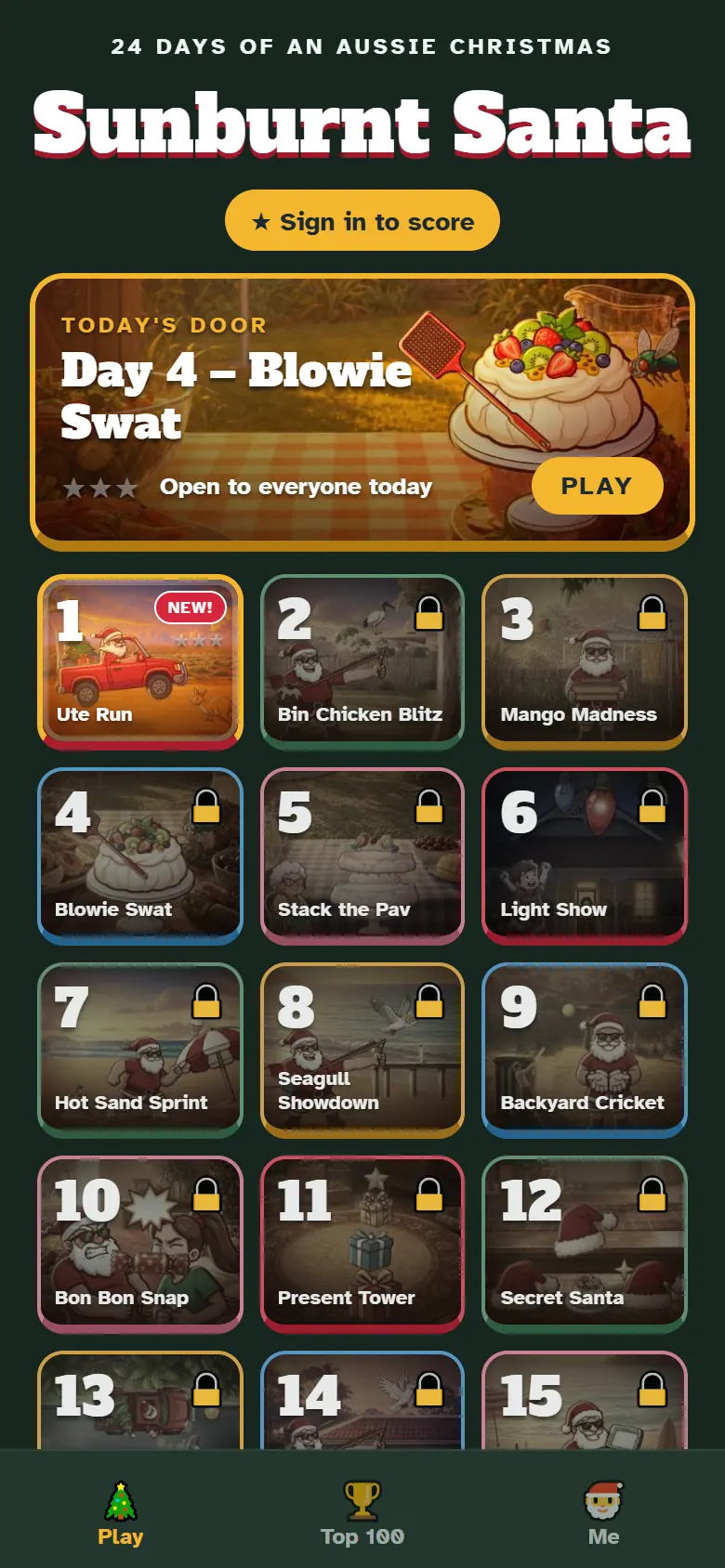
Sunburnt Santa is our take on the idea: a free advent calendar game with 24 Aussie Christmas mini-games, one door a day. Your calendar starts the day you first open it (door 1 that day, door 2 the next), and in December everyone catches up, so on 1 to 24 December every door up to that date is open. Door 1 is Ute Run: Santa has swapped the sleigh for a red ute, and the roos are on the road. It's a long way from chalk marks on a door, but it's the same small joy of opening one more door each day.
Keep reading
- Digital advent calendars and advent calendar games
- Christmas traditions around the world: 35 countries, region by region
Sources
- What is Advent and why do we celebrate with calendars?, National Geographic
- History of the Advent calendar, Richard Sellmer Verlag
- Company history, Richard Sellmer Verlag
- Crafting from the Collections: Making an Advent Calendar, Library of Congress Blogs
- Liturgical calendar, November 2026, Liturgy Office, Catholic Bishops' Conference of England and Wales
- Advent in the Orthodox Christian Church, Greek Orthodox Archdiocese of America